Amapiano has become one of the most searched-for genres in AI music generation, and for good reason. Its rolling log drum bass, warm piano chords, and spacious dance-floor groove make it instantly recognizable — but also surprisingly tricky to recreate with a text prompt. Type “afro dance beat” into Suno and you’ll usually get something generic. Type a well-structured Amapiano prompt, and you can get shockingly close to the real thing.
This guide breaks down what Amapiano actually is, why it’s a genre that AI tools handle unevenly, and exactly how to structure Suno prompts that capture the log drum, the piano groove, and the vocal or instrumental identity that defines the sound.
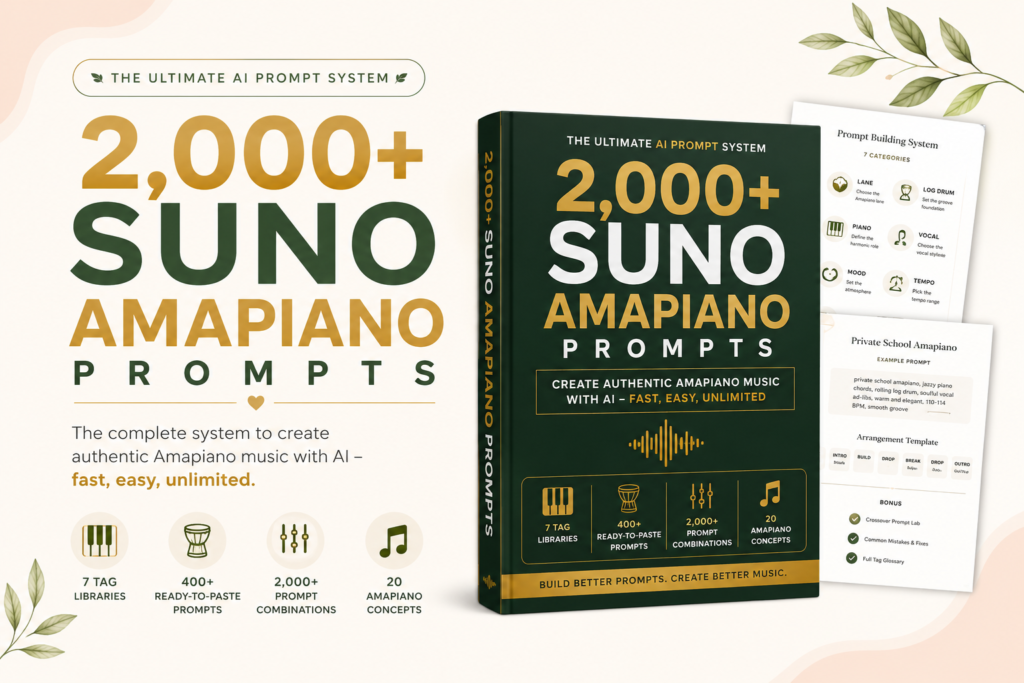
Want the shortcut? We put together a library of 2,000+ ready-to-use Suno prompts for Amapiano — every sub-style, log drum variation, and vocal/instrumental combo already written out, so you can skip the trial and error below and start generating straight away.
What Is Amapiano, Exactly?
Amapiano is a South African house-adjacent genre that blends deep house, jazz, kwaito, gqom, soul, and lounge influences into something entirely its own. The name comes from the Zulu word for “the pianos,” which points directly at one of its core identifiers: warm, jazzy piano chords sitting on top of a slow, syncopated groove. According to Wikipedia’s overview of the genre, Amapiano developed in the townships around Johannesburg and Pretoria during the mid-2010s and exploded into mainstream popularity by the early 2020s, eventually producing global crossover hits and spawning fusion subgenres across Nigeria, Tanzania, and beyond.
Unlike most House subgenres, Amapiano rarely sticks to a strict four-on-the-floor pattern. As EDMProd’s breakdown of the genre explains, the drums are usually syncopated and shuffled, built from shakers, congas, and bongos rather than a rigid kick pattern, which gives the whole track a loose, groove-forward feel instead of a driving club pulse.
Tempo-wise, Amapiano typically sits in the 108–115 BPM range — noticeably slower than Afro House or Tech House, but the groove is layered in a way that still pulls people onto the dance floor. The genre also leans heavily on vocal storytelling, usually in Zulu, Xhosa, or Sesotho, though English vocals and fully instrumental versions are both common.
The Log Drum: Amapiano’s Signature Sound
If there’s one element that separates Amapiano from every other House-adjacent genre, it’s the log drum. This is a deep, percussive bass sound — often described as a modulated, pitch-bending bassline — that sits off-beat from the main drum pattern and gives the track its bounce. Splice’s guide to Amapiano notes that this bass sound has become so central to the genre’s identity that many producers treat it as non-negotiable; a track without a recognizable log drum rarely reads as “real” Amapiano to listeners.
In modern, club-oriented Amapiano, producers often layer a sub-bass underneath the log drum to give it more physical weight on a big sound system, while keeping the melodic log drum pattern doing the rhythmic work.
This matters enormously for AI prompting. If your Suno prompt doesn’t explicitly reference the log drum or its behavior, the model has no strong signal to reach for that sound, and you’ll often end up with a generic Afro House or Afrobeats result instead.
Why AI Tools Struggle With Amapiano
Amapiano is a groove-first genre. Its identity depends less on melody and more on rhythmic architecture — how the log drum sits against the shakers, how much space is left in the arrangement, how the piano phrases repeat and breathe. That’s a harder thing for a text-to-music model to infer than something like tempo or instrumentation.
In practice, Suno tends to handle the following reasonably well:
- A loose, rolling groove structure
- Warm, jazzy piano chords
- Repetitive, dance-friendly phrasing
- An open, spacious arrangement feel
Where it tends to struggle:
- Getting the log drum’s syncopation and pitch movement right
- Keeping the mix spacious instead of cluttered
- Avoiding drift into generic Afro House or Afrobeats territory
- Balancing vocals, piano, and bass without flattening the groove
The fix isn’t complicated, but it does require being deliberate. Every strong Amapiano prompt should define four things: the sub-style or lane you want, the log drum’s role, the piano’s role, and whether you’re going for a vocal or instrumental result.
Anatomy of a Strong Amapiano Prompt
A reliable Amapiano prompt structure looks something like this:
[Amapiano lane] + [log drum/bass description] + [piano/chord description] + [groove and percussion spacing] + [vocal or instrumental target]
Some useful tags to pull from when building your own prompts:
- amapiano
- log drum
- piano groove
- deep groove
- rolling percussion
- shaker rhythm
- warm keys
- vocal amapiano
- instrumental amapiano
- dance-floor bounce
- spacious mix
- south african club vibe
Here are five example prompts you can adapt directly:
- Amapiano, log drum groove, warm piano chords, rolling percussion, spacious dance-floor bounce
- Vocal amapiano, deep groove, log drum movement, piano-led hook, south african club vibe
- Instrumental amapiano, shaker rhythm, warm keys, rolling percussion, deep party energy
- Private school amapiano, polished piano motif, log drum support, spacious groove, elegant dance flow
- Amapiano club track, deep low end, piano groove, chant-style vocal feel, open rhythmic movement
If you want a much larger library of ready-to-use prompt structures across genres, not just Amapiano, our 10,000 Suno AI prompts collection is a good next stop — it’s built around the same “lane + core sound + texture + vocal target” logic used above.
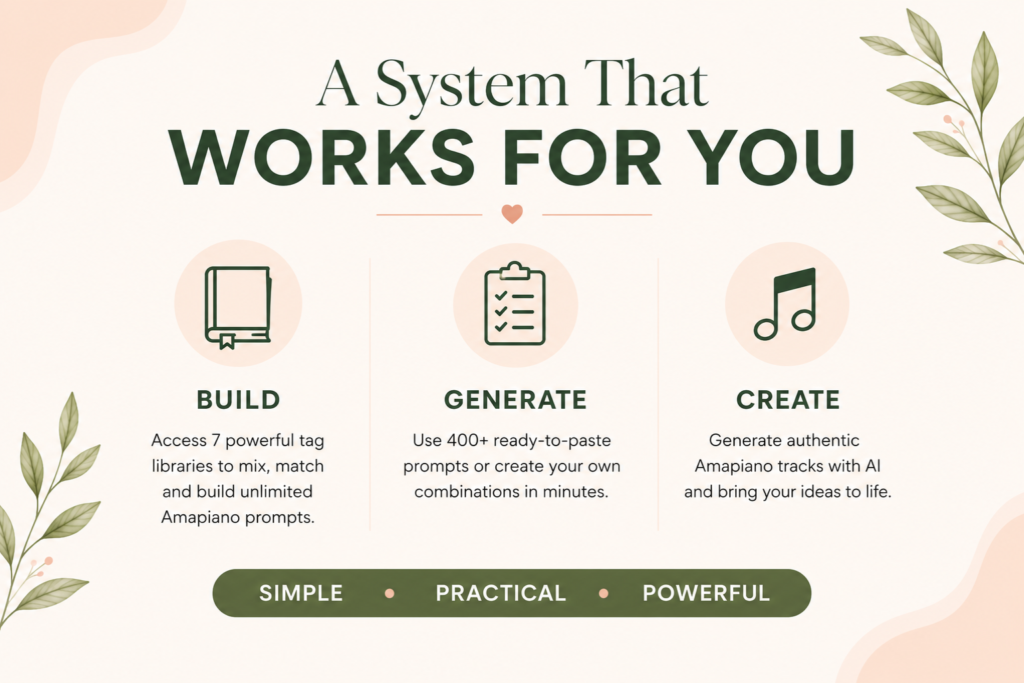
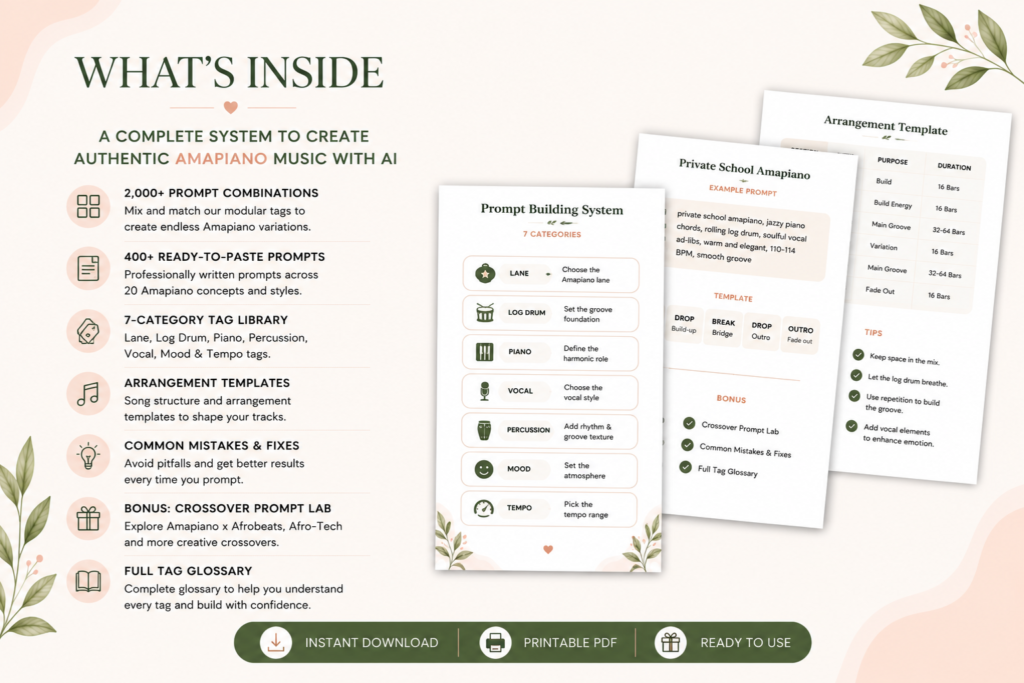
Five examples is enough to get started, but it’s a fraction of the ground worth covering. Our 2,000+ Suno Prompts for Amapiano ebook expands this same framework across every sub-style, tempo range, and log drum variation in the genre, so you’re never stuck rewriting the same handful of prompts over and over.
Amapiano Sub-Styles Worth Prompting Separately
Amapiano isn’t one monolithic sound, and treating it that way is one of the most common reasons AI-generated tracks come out flat or generic. Prompting for a specific sub-style gives the model a much tighter target.
Private School Amapiano leans jazzier and more refined, often built around cleaner arrangements, softer log drums, and a more polished, “grown and sexy” mood. Prompt with words like polished piano motif and elegant dance flow.
Vocal Amapiano is more song-structured, built around hooks and toplines rather than pure groove. This is the lane to reach for if you want something closer to a radio-ready single than a DJ tool.
Instrumental / Groove-Heavy Amapiano puts all the weight on the log drum, piano motifs, and percussion, without vocals competing for space. It’s the most DJ-friendly version of the genre and often the easiest for AI to execute convincingly.
Piano-Tech / Hybrid Club Amapiano pushes the tempo and energy harder, blending in elements from Afro House and Afro Tech while keeping the core Amapiano groove intact.
Naming the sub-style directly in your prompt — rather than just typing “amapiano” — is one of the single highest-leverage changes you can make to get more consistent, more authentic-sounding results. If you’d rather not write and test dozens of sub-style variations yourself, the 2,000+ Amapiano prompt pack already has private school, vocal, instrumental, and hybrid club prompts broken out separately and ready to paste into Suno.
A Short History Lesson (Why It Actually Helps Your Prompts)
Understanding where Amapiano came from isn’t just trivia — it explains why certain prompt words work better than others. The genre grew out of township parties, taxi sound systems, and underground DJ culture in and around Johannesburg and Pretoria, blending kwaito’s rhythmic swagger with the harmonic sensibility of deep house and jazz. It spread first through word of mouth and social media rather than radio, which is part of why so much of the genre’s identity is built around danceability and repetition rather than radio-friendly song structure.
Kabza De Small is widely regarded as one of the genre’s most influential pioneers, and figures like DJ Maphorisa helped push the sound from an underground South African movement into a global phenomenon. Artists like Focalistic brought a hip-hop-inflected vocal style into the genre, while producers like Vigro Deep leaned into darker, more experimental, deep-house-adjacent textures. By the early 2020s, Amapiano had crossed over internationally, eventually producing global hits and fusion offshoots like Afropiano, Bongopiano, and Popiano across different regions and scenes.
Why does this matter for prompting? Because Amapiano was never a studio-engineered genre built from a rulebook — it evolved organically around groove, repetition, and space. That’s exactly why vague, generic-sounding prompts fail so often: they try to describe a feeling (“chill African dance vibe”) instead of describing the architecture that produces that feeling (log drum, piano phrasing, spacing, tempo). The more you understand the genre’s actual building blocks, the more precisely you can translate them into prompt language Suno can act on.
Common Amapiano Prompting Mistakes (And How to Fix Them)
Only writing “afro dance” or “african beat.” This is far too broad, and Suno will often default to generic Afrobeats or House instead of Amapiano specifically. Always name the genre directly, along with at least one sub-style or defining trait.
Leaving out the log drum entirely. Without a direct reference to the log drum or a “groove-punctuating bass” description, you lose one of the genre’s most identifiable signatures. Even a short phrase like log drum bassline makes a measurable difference.
Overcrowding the arrangement. Amapiano needs room to breathe. If your prompt stacks too many competing elements — heavy synths, dense layering, aggressive drums — you’ll pull the result away from the genre’s spacious, rolling feel. Keep the instrumentation list short and intentional.
Skipping the piano identity. It’s easy to focus so much on the log drum that the piano gets forgotten, but piano phrasing is where a lot of the genre’s warmth and character comes from. Include something like warm keys or piano motif in every prompt.
Forcing too much tempo or aggression. Amapiano isn’t meant to sprint. Pushing the BPM or intensity too high tends to nudge the output toward generic club music instead of the genre’s signature rolling groove.
Turning AI Amapiano Sketches Into Finished Tracks
One thing worth understanding going in: Suno-generated Amapiano works best as a starting point, not a finished master. Producers who are getting strong results are typically pulling stems, extracting MIDI from AI-generated loops, and rebuilding elements — drums, bass, keys — inside a DAW using sample packs and live instrumentation layered on top of what the AI produced. That workflow lets you keep the parts of the AI generation that sound authentic (a nice chord voicing, an interesting vocal phrase) while fixing the parts that don’t (a log drum that isn’t quite syncopated correctly, or a mix that’s too dense).
If your goal is a specific vocal performance or an existing melodic idea reimagined in Amapiano style, it’s worth reading our guide on Suno prompts for covers, which covers how to steer the model toward a target style without losing the core melodic identity you’re working from.
And if you’ve had success blending Amapiano with other regional sounds, our K-Pop Suno prompt guide is a useful companion piece — cross-genre fusion prompting (like Afropiano or K-pop-adjacent hybrids) follows a lot of the same “define the lane, then layer the traits” logic covered here.
Stop Guessing, Start Generating
Everything above will help you write better Amapiano prompts from scratch — but if you want the fastest path to consistent, authentic-sounding results, that work has already been done for you. The 2,000+ Suno Prompts for Amapiano ebook is built entirely around the log drum, piano-groove, and sub-style framework covered in this guide, with thousands of tested, ready-to-paste prompts organized by mood, tempo, and vocal style.
Quick FAQ
What defines Amapiano? A rolling, spacious groove built around log drum bass, warm piano chords, and syncopated percussion, usually sitting between 108 and 115 BPM.
What BPM is typical for Amapiano? Most Amapiano tracks fall between 108 and 115 BPM, slower than most House and Afro House subgenres.
What’s the difference between Amapiano and Afro House? Afro House tends to keep a steadier four-on-the-floor pulse and higher tempo, while Amapiano is looser, slower, and built specifically around the log drum and piano-led groove.
Can Suno generate convincing Amapiano? Yes, especially when the prompt clearly names the sub-style, the log drum’s role, the piano’s role, and whether you want vocal or instrumental output. Vague prompts tend to drift toward generic Afro House or Afrobeats instead.
Why do some AI Amapiano tracks sound “off”? Usually because the log drum’s syncopation is missing or wrong, the arrangement is too crowded, or the prompt never named Amapiano specifically as opposed to a broader “African dance” descriptor.
Get the Full Prompt Library
The prompt structures in this guide will get you a strong first draft, but Amapiano rewards precision — small wording changes in how you describe the log drum, the groove spacing, or the piano voicing can shift the result dramatically. For a broader, tested library of Afro-genre prompt formulas and troubleshooting fixes for flat grooves and Afro House drift, our full Suno AI prompt guide PDF covers the general framework across genres.
But if Amapiano is specifically your lane, don’t stop at five examples. The 2,000+ Suno Prompts for Amapiano ebook gives you the full, genre-specific version of everything covered here — thousands of tested prompts across every sub-style, tempo, and vocal target, so every track you generate starts from a stronger foundation. Get the ebook →