Type “rap beat” into Suno and you already know what you’ll get back: a thin loop, a buried 808, and a flow that drifts off the beat like it’s not sure it wants to be there. It’s not broken. It’s just guessing — and it’s guessing because your prompt gave it almost nothing to work with.
Hip-hop is, without much competition, the hardest genre to generate well in Suno. Not because the model is weak. Because “rap” isn’t one sound — it’s dozens of them, each defined by a different drum machine, a different 808 behavior, a different era, a different region. Tell Suno “rap” and it averages across all of that. You get nothing in particular. You get the AI-music equivalent of elevator music with a snare roll.
This page exists for one reason: to show you exactly why that keeps happening, and to hand you 1,000 prompts that already fixed it — organized by subgenre, tested against how Suno v5.5 actually behaves, and ready to paste in under ten seconds.
The Real Reason Your Suno Rap Sounds Like Everyone Else’s
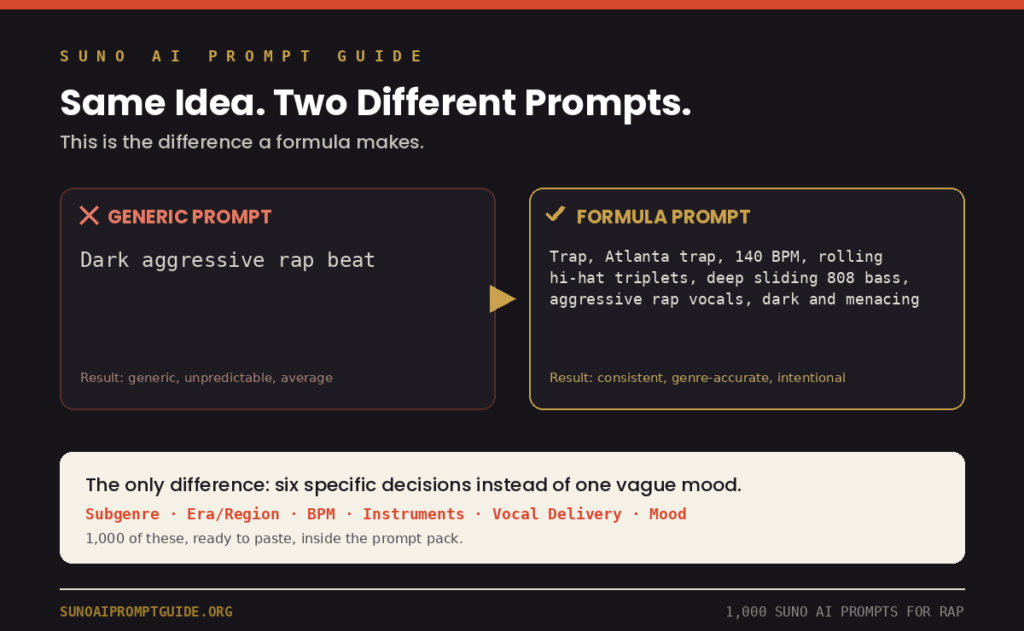
Here’s the part most people never figure out on their own: Suno doesn’t need more words in a prompt. It needs the right words, in the right order, describing decisions instead of vibes.
“Dark aggressive rap beat” is a vibe. Suno doesn’t know what to do with it, so it picks something generic and hopes it’s close enough.
“Trap, Atlanta trap, 140 BPM, deep sliding 808 bass, rolling hi-hat triplets, aggressive rap vocals, dark and menacing” is a decision. Every word in that string tells Suno something concrete: which drum machine character to reach for, how the 808 should move, what era and region to anchor the mix to, and what the vocal delivery should sound like. That’s not a lucky prompt. That’s a formula — and once you see it, you can’t unsee how many “Suno prompts for rap” lists online skip it entirely.
Most free prompt lists give you five or six generic examples and call it a day. They don’t tell you why those prompts work, so the moment you try to adapt one to your own idea, you’re right back to guessing.
Read also: Suno AI Prompt Guide for Christian Music
What Actually Makes a Rap Prompt Work in Suno
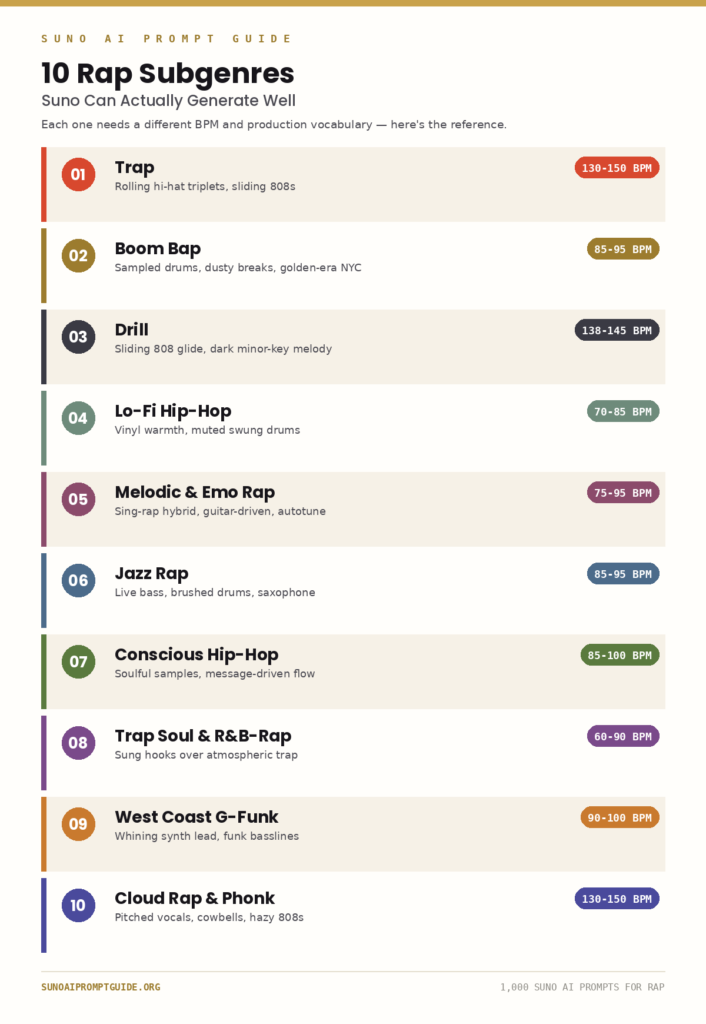
Every prompt that reliably produces real-sounding hip-hop in Suno follows roughly the same shape:
[Subgenre] + [Era or Region] + [BPM] + [Key Instruments] + [Vocal Delivery] + [Mood]
Skip any one of those six pieces and the result drifts. Skip the era and region, and Suno defaults to a generic modern radio sound no matter how specific your instrument list is. Skip the vocal delivery, and Suno — which defaults toward melody — will hand you a sung hook when you wanted bars. Skip the BPM, or worse, describe it as “medium tempo,” and you’ve given the model nothing to lock onto at all.
This isn’t a theory. It’s the pattern behind every trap, drill, and boom bap track that actually sounds intentional instead of like a stock-music placeholder. And it’s the exact formula behind all 1,000 prompts inside the pack below.
Three Free Samples (So You Can Hear the Difference Yourself)
Before you take our word for it, paste these into Suno’s Style field and compare them to whatever you were typing before:
Trap: Trap, Atlanta trap, 140 BPM, rolling hi-hat triplets, deep sliding 808 bass, aggressive rap vocals, dark and menacing
Boom Bap: Boom Bap, golden-era New York hip-hop, 90 BPM, dusty SP-1200 drums, chopped jazz piano sample, lyrical rap flow, raw and nostalgic
Drill: Drill, UK drill, 140 BPM, sliding 808 bass glide, dark minor-key piano melody, aggressive drill flow, menacing and dark
Notice what’s different from a normal Suno prompt: no adjectives doing all the work alone, no vague “hip-hop beat” with nothing to anchor it. Every word is a production choice.
Those three are a preview. The full pack has 997 more — plus the eight variables you’d need to write dozens of your own from scratch.
Get the Full 1,000-Prompt Pack on Gumroad →
What’s Actually Inside the Pack
This isn’t a PDF of five prompts stretched across forty pages. It’s a working reference built to sit open next to Suno while you write.
- 1,000 unique, numbered Style-field prompts (0001–1000), organized into 10 subgenre chapters — no repeats, no filler, no “just change one word” duplicates padding the count.
- A short front-matter guide explaining how Suno’s Style, Lyrics, and Exclude fields actually work — most people never learn the difference, and it’s the reason half their prompts underperform.
- A meta-tag reference: every structure tag that controls song sections —
[Verse],[Hook],[Bridge], ad-lib formatting — so you can turn any Style prompt into a full structured song. - A subgenre field guide with the correct BPM range and defining traits for each style, so you’re never guessing whether trap sits at 90 BPM or 140.
- A common-mistakes chapter covering the exact errors that make AI rap sound generic — vague tempo language, missing era/region anchors, singing instead of rapping.
- 10 bonus full-song blueprints — a complete Style + Lyrics pairing for each subgenre, showing you how a finished submission actually looks.
- Clean layout, easy-to-read type, built for scanning on a laptop while you work — not a wall of grey text.
Every Rap Subgenre Suno Can Actually Generate Well
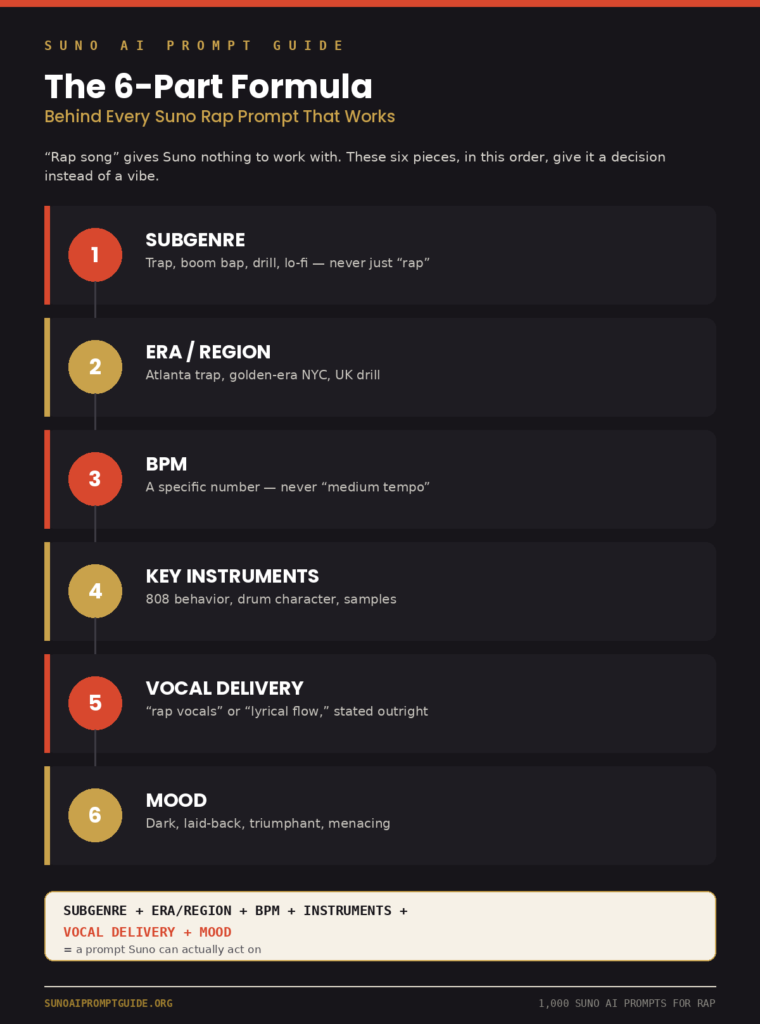
If you’ve searched “suno prompts for rap” before landing here, you’ve probably noticed most lists only cover trap and call it done. Rap is bigger than that, and Suno can generate all of the following convincingly — if you know the formula for each one. This pack covers all ten:
Trap (130–150 BPM) — rolling hi-hats, sliding 808s, the sound most people mean when they say “modern rap beat.” 100 prompts covering Atlanta trap, dark cinematic trap, rage-trap, and more.
Boom Bap (85–95 BPM) — sampled drums, dusty breaks, golden-era New York. For anyone chasing that ’90s East Coast sound.
Drill (138–145 BPM) — sliding 808 glides and minor-key menace, UK and Brooklyn variants both covered.
Lo-Fi Hip-Hop (70–85 BPM) — vinyl warmth, muted drums, built for the study-beats and chillhop crowd.
Melodic & Emo Rap (75–95 BPM) — the SoundCloud-era sing-rap hybrid, guitar-driven and autotune-heavy.
Jazz Rap (85–95 BPM) — live-feel instrumentation, upright bass, saxophone, a completely different lane from sample-chop boom bap.
Conscious Hip-Hop (85–100 BPM) — soulful, message-driven production for storytelling-first tracks.
Trap Soul & R&B-Rap (60–90 BPM) — sung hooks over moody, atmospheric trap production.
West Coast G-Funk (90–100 BPM) — whining synth leads and funk basslines, the Long Beach sound.
Cloud Rap & Phonk (130–150 BPM) — pitched vocals, cowbells, distorted 808s, hazy atmosphere.
Ten sounds. One hundred tested prompts each. Zero guesswork.
See the Full Prompt List Inside →
Who This Pack Is Actually For
This isn’t aimed at people who want to memorize music theory. It’s built for:
- Content creators who need a background track fast and don’t have twenty minutes to fight a prompt box before every video.
- Artists prototyping ideas who want to hear a concept in a specific subgenre before booking real studio time.
- Producers experimenting with AI tools who already understand hip-hop production and just want the prompt vocabulary that translates it into something Suno understands.
- Anyone who’s tried Suno for rap already and been disappointed — because the fix usually isn’t “try harder,” it’s “use the right six variables.”
If you’ve ever regenerated the same Suno prompt eight times hoping the ninth one finally sounds right, this pack replaces that guesswork with prompts that were built to work the first time.
Read also: Suno Prompts for Amapiano
Why Not Just Use a Free Prompt List?
You could. Most free lists online give you five to ten examples per genre, usually without any explanation of why they’re built the way they are — which means the moment you want something slightly different, you’re stuck reverse-engineering the formula yourself.
This pack gives you the formula and a thousand finished examples of it in action, across ten genres, so you’re never short of a starting point and you understand exactly which word to change when you want a different result. Think of the free lists as a taste. This is the whole meal, plus the recipe.
Three Rules You Can Use Right Now, Even Before You Buy Anything
You don’t need the full pack to see an improvement today. If you only take three things from this page, take these:
1. Never write “rap” alone. Pair it with a subgenre every time — trap, boom bap, drill, whatever you’re going for. “Rap” spans dozens of production styles, and without a subgenre attached, Suno has to guess which one you mean. It usually guesses wrong.
2. Always name a BPM, never a feeling. “Upbeat” and “medium tempo” aren’t targets Suno can act on. A number is. Trap wants 130–150. Boom bap wants 85–95. Drill wants 138–145. Get the number right for the genre and half your battle is already won.
3. Say the vocal delivery out loud in the prompt. Suno defaults toward melody unless you tell it otherwise. If you want bars instead of a sung hook, put “rap vocals” or “lyrical flow” directly in the Style field. It’s one phrase, and it’s the single most skipped step in every free prompt list we’ve seen.
Try those three rules on your next five generations. Then imagine having 1,000 prompts that already apply them correctly, sorted by exactly the sound you’re chasing.
Read also: Suno AI K-Pop Prompting Guide
Frequently Asked Questions
Does this work with the current version of Suno? Yes — every prompt is written for Suno v5.5 prompt behavior as of 2026. Suno updates its model periodically, so if a prompt ever behaves differently than expected, the guide includes a section on adjusting one variable at a time rather than starting over.
Will these prompts guarantee a specific result? No prompt can guarantee an exact output — Suno’s generations vary, and results depend on the model version, your lyrics, and normal generation randomness. What these prompts do reliably is anchor Suno toward the right kind of sound instead of a generic default, which is the difference most people are actually looking for.
Do I need to write my own lyrics? The 1,000 prompts are all written for Suno’s Style field, which controls the overall sound rather than the words. The guide includes a meta-tag reference and 10 full Style + Lyrics blueprints so you can see exactly how to pair a Style prompt with a structured Lyrics field once you’re ready to write your own bars.
Is this only for trap music? No — that’s the most common gap in other prompt lists. This pack covers ten distinct subgenres, from boom bap and drill to jazz rap and G-funk, each with its own correct BPM range and production vocabulary.
What format is the ebook? A clean, easy-to-read PDF, laid out for quick scanning — numbered prompts, chapter dividers by subgenre, and a table of contents so you can jump straight to the sound you need.
Stop Guessing. Start Pasting.
Every generic Suno rap track has the same root cause: a prompt that describes a vibe instead of a decision. You now know the six-part formula that fixes it. The only question left is whether you want to spend the next hour writing and testing your own 1,000 variations — or open the file and start pasting.
Get 1,000 Suno AI Prompts for Rap →
Ten subgenres. One thousand prompts. Zero filler.
Still getting generic Suno rap beats?
See the exact prompt formula that fixes it →
1,000 tested prompts inside · Instant download