You type “Christian song” into Suno. You hit create. What comes back sounds like a generic pop track with no heart in it. No choir swell. No quiet piano moment. No sense that the song was made to lift a prayer, not just fill a playlist.
This happens for one reason. Suno needs real direction. It has heard countless hours of gospel, hymns, and worship music, and it can make music that sounds true to that history. But it can only do that when you give it clear, specific words to work with.
That is what this guide does for you. The Suno AI prompt guide for Christian music gives you 2,000 ready-to-use prompts across 20 styles, from Southern Gospel to soft, relaxing worship beds you can play at night. Each prompt is written, tested, and ready to paste straight into Suno.
Get the full 2,000-prompt guide here →
A Short Look at Where Christian Music Comes From
Christian music is not one sound. It is a wide tree with many branches. It started with simple, one-note chants sung in early churches, grew into full hymns during the Reformation, and later split into the many styles we hear today, from gospel choirs to Christian hip hop. This long history is well documented on Wikipedia’s Christian music page, which traces the path from Gregorian chant through hymnals to modern Contemporary Christian Music (CCM).
That history matters here for a simple reason. Every style of Christian music, from a quiet chant to a stadium worship anthem, has its own instruments, tempo, and mood. If you want Suno to sound right, your prompt needs to name that style clearly. A vague prompt gets a vague, forgettable song. A specific prompt gets a song with real character.
How to Make a Gospel Song with AI
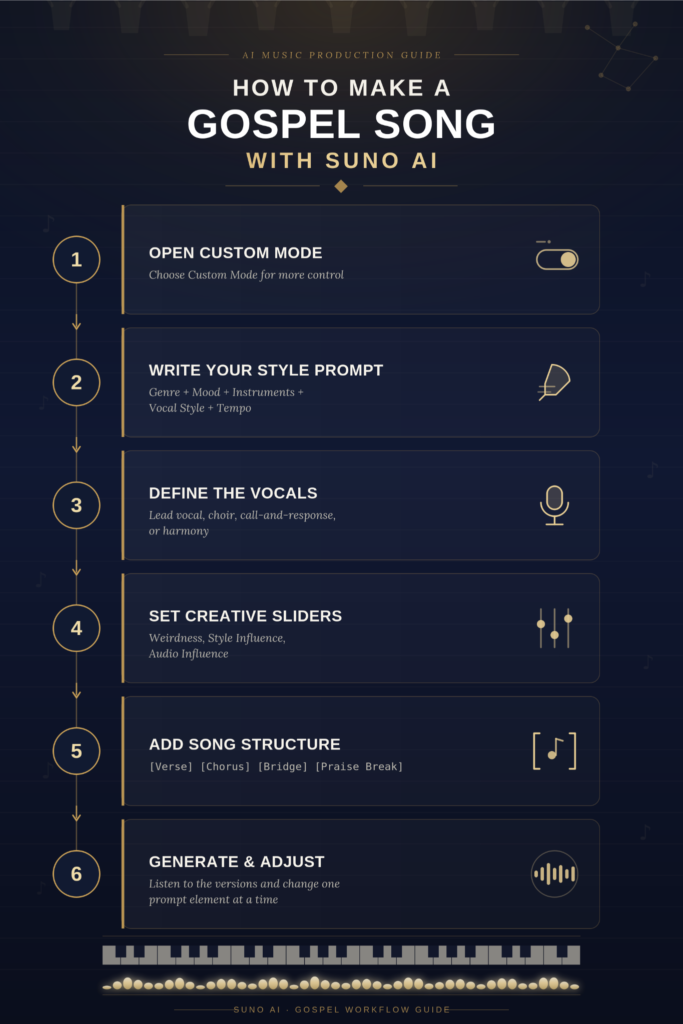
If your main question is how to make a gospel song with AI, the steps below will get you there in a few minutes.
Step 1: Open Custom Mode. Simple Mode only takes one line of text. Custom Mode gives you separate boxes for Style of Music, Lyrics, and Title, plus sliders for extra control. Gospel music needs that extra control, since a real gospel sound depends on specific instruments and vocal choices.
Step 2: Write a style prompt with five parts. A strong Suno prompt for gospel music follows a simple formula:
Genre + Mood + Instruments + Vocal style + Tempo
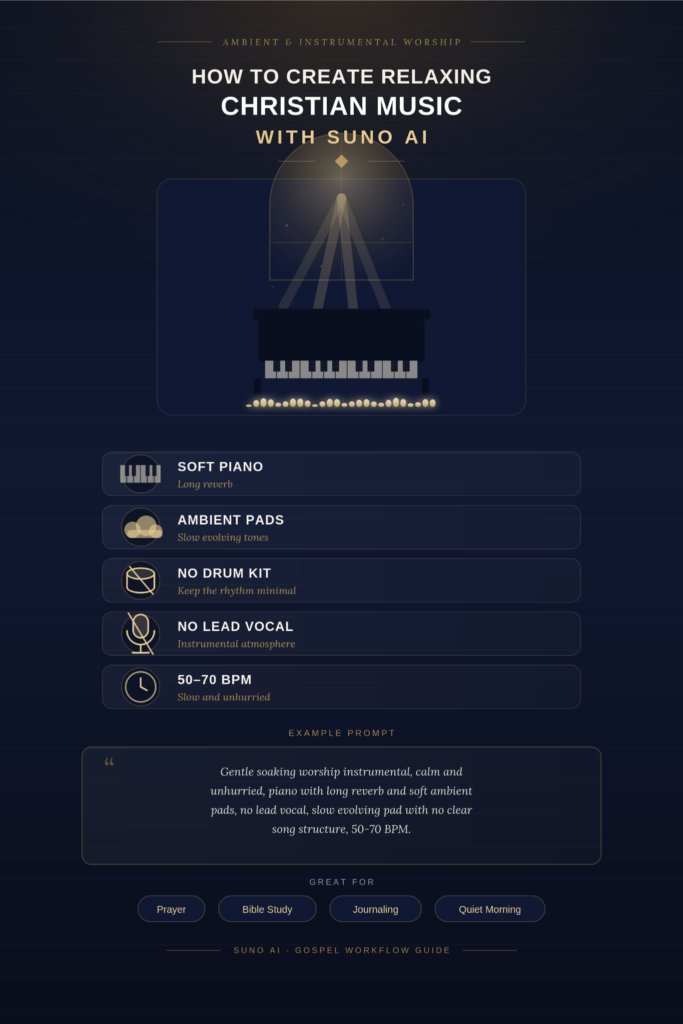
For example: Traditional black gospel, emotional and powerful, Hammond organ and live drums, soulful female lead with choir backing, slow 6/8 time.
That one line tells Suno exactly what kind of song to build. Compare that to just typing “gospel song,” and you can hear why the second result falls flat.
Step 3: Name the vocal style clearly. Gospel lives or dies on the vocal. Say whether you want a soulful female lead, a call-and-response choir, or a male lead with a bass singer answer line. Suno reads these details and shapes the vocal performance around them.
Step 4: Set your sliders. Suno’s Custom Mode gives you three Creative Sliders: Weirdness, Style Influence, and Audio Influence. Weirdness runs from Safe to Chaos, with 50% as a normal, balanced setting. Style Influence controls how closely Suno follows your prompt, from Loose to Strong. For most gospel and worship prompts, keep Weirdness low to medium and Style Influence on the higher side, so the song stays true to the sound you asked for.
Step 5: Add structure tags if you write your own lyrics. Tags like [Verse], [Chorus], [Bridge], and [Praise Break] help Suno follow a normal song shape. If you leave the Lyrics box empty, Suno will write lyrics based on your style prompt instead.
Step 6: Generate, listen, and adjust. Suno usually gives you two versions per generation. If neither is quite right, change one part of the prompt at a time, such as swapping “choir backing” for “call-and-response choir,” rather than rewriting the whole thing.
Once you have this formula down, you can build gospel songs, worship anthems, or quiet prayer music in minutes instead of guessing for an hour. Our full Suno AI prompt guide for Christian music gives you 100 tested prompts for gospel and choir styles alone, so you never have to start from a blank box.
The Prompt Formula, Style by Style
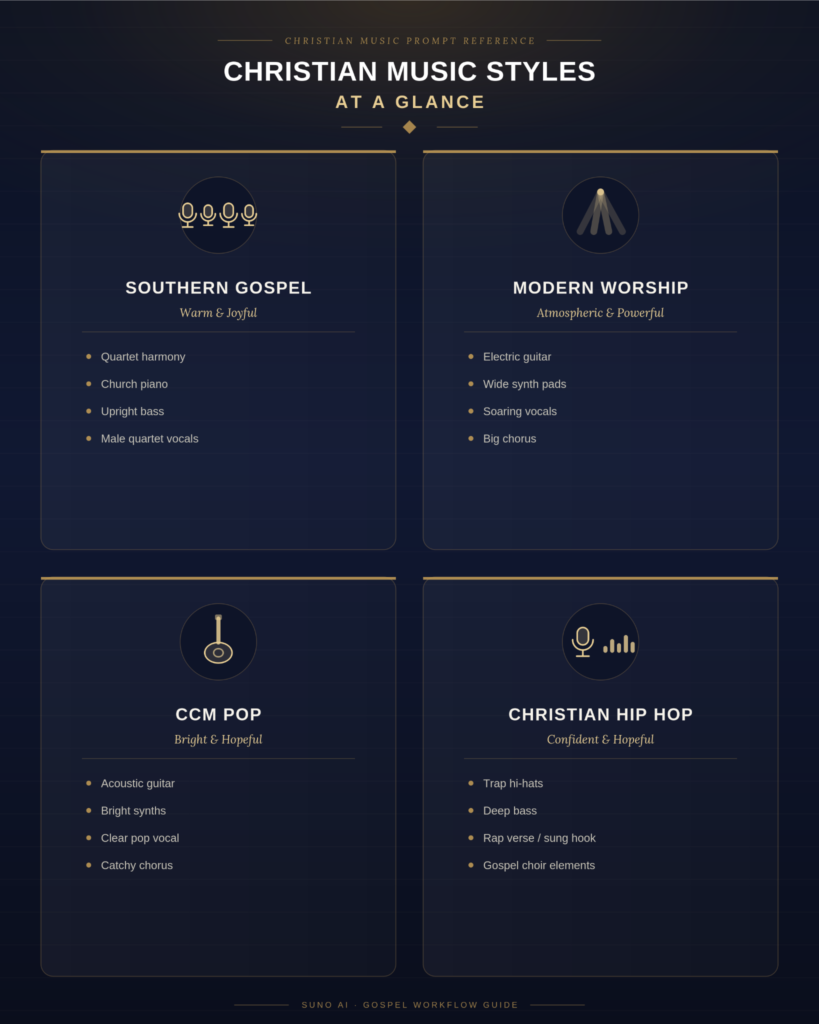
Christian music covers a wide range of sound, and each style needs its own version of the formula above. Here is how it plays out across a few popular styles.
Southern Gospel: Southern Gospel leans on tight quartet harmony and a steady, joyful beat. Try: Southern Gospel quartet harmony, joyful and warm, church piano and upright bass, male quartet harmony with bass singer answer line, key change before final chorus.
Modern Worship: This style is built for big rooms and soaring choruses. Try: Stadium worship anthem, atmospheric and building, delay-heavy electric guitar and wide synth pads, soaring male lead vocal, quiet intro building to a huge chorus.
CCM Pop: Bright, catchy, and radio-ready. Try: Upbeat Christian pop song, hopeful and polished, acoustic guitar and bright synths, clear female pop vocal, catchy repeatable chorus hook, 115 BPM.
Christian Hip Hop: Rhythm-driven with a message. Try: Christian hip hop anthem, confident and hopeful, trap hi-hats and deep bass with a gospel choir stab, rap verse with a sung hook.
If you want a shortcut into any of these, the guide covers 20 full chapters like these, each with 100 ready-made prompts and a short tip on how to fine-tune it. Grab the full guide here →
Relaxing Christian Music: Prompts for Rest and Prayer
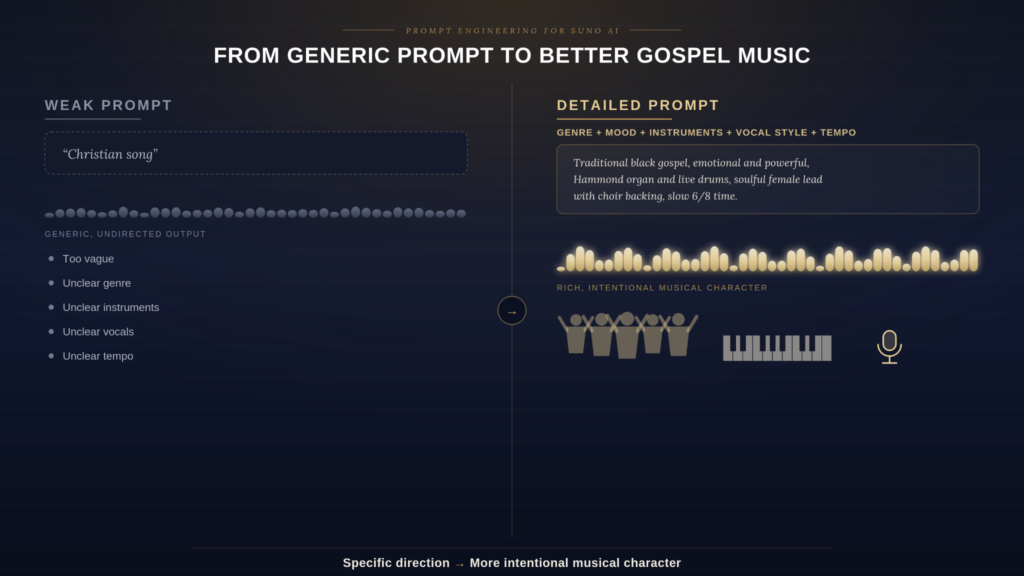
Not every Christian song needs a big chorus or a driving beat. A growing number of people search for relaxing Christian music to play during quiet prayer, Bible study, or just to slow down after a hard day. Suno can build this kind of music extremely well, but the prompt needs to point it away from rhythm and toward space and stillness.
For relaxing Christian music, drop the drum kit and lean on long, slow tones instead. Try: Gentle soaking worship instrumental, calm and unhurried, piano with long reverb and soft ambient pads, no lead vocal, slow evolving pad with no clear song structure, 50-70 BPM. This kind of prompt gives you a soft bed of sound that works well behind prayer, journaling, or a quiet morning.
Soft Christian Music to Sleep By: Prompts for Rest
Sleep music asks for something even quieter. If you are building soft Christian music to sleep to, or looking for Christian music to sleep by, keep the tempo very slow, avoid any clear beat, and ask for a long, gentle fade instead of a normal song structure.
A good starting prompt looks like this: Calming Christian sleep soundscape, soft and drifting, gentle strings and a slow ambient tone, no vocal, very slow build with no strong beat, long fade in and long fade out, 40-60 BPM. Keep Weirdness very low here, since a sleep track needs to stay smooth and predictable from start to finish. A sudden shift in volume or a surprise instrument can pull a listener right out of rest.
This soft, ambient side of Christian music has a long history behind it too. Long before AI tools existed, quiet instrumental worship music, like solo organ pieces played in European churches during the Baroque period, served this same purpose: giving people a calm space to sit with their faith without any need for words. Suno lets you build that same kind of space today, in any mood or instrument set you choose.
If sleep and prayer music is your main goal, the guide includes full chapters on soaking worship, lo-fi Christian beats, and sleep-specific instrumentals, each with 100 prompts built around this slow, spacious sound. See the full prompt list here →
Why a Prompt Guide Beats Typing It Yourself
You can, of course, write your own Suno prompts from scratch. Many people do, and after enough tries, most land on something decent. But a few real problems come up along the way.
First, it takes time. Getting from a vague idea to a prompt that actually captures a style like Southern Gospel or urban choir Gospel usually takes several rounds of trial and error.
Second, styles blur together easily. Gospel, worship, and CCM share some instruments and moods, but a prompt written for one often falls flat for another. A guide built style by style saves you from that guesswork.
Third, a tested prompt already avoids common mistakes, like forgetting a choir direction, leaving out a tempo, or asking for a mood that fights the instruments you listed. Every prompt in our guide has already worked through those issues, so you get a usable result on the first try far more often.
If you also want to turn an existing worship song into a fresh AI cover, or explore prompts outside Christian music, our site has more resources built the same way. Check out our guide on Suno prompts for covers if you want to reimagine a song you already love, or browse our full PDF prompt guides if you want more than one style pack. If your taste runs wider than Christian music, we also cover K-pop prompts and Amapiano prompts, and for the most complete option, our 10,000 Suno AI prompt library covers nearly every genre in one place.
Frequently Asked Questions
How do I make a gospel song with AI? Open Custom Mode in Suno, write a style prompt with genre, mood, instruments, vocal style, and tempo, then set your Creative Sliders and generate. See the full step-by-step walkthrough above.
Can I use AI-made worship music in my church? Suno’s terms give commercial rights to Pro and Premier account holders for songs they generate, so many worship leaders use these tracks for sermons, background music, or demo tracks for their band. Always check Suno’s current terms of service before public or commercial use.
What is the best Suno prompt for relaxing Christian music? Focus on slow tempo, soft instruments like piano and strings, long reverb, and no drum kit. Naming “no lead vocal” also helps keep the track calm and instrumental.
Does this guide work with the newest Suno models? Yes. The prompt formula in this guide, genre, mood, instruments, vocal style, and tempo, works across Suno’s model versions, since it is built on how Suno reads style descriptions rather than one specific version’s quirks.
Is Christian music only in English? Not at all. Christian music is sung and recorded in hundreds of languages worldwide. Groups like Jehovah’s Witnesses record their full music library in over 500 languages, free to stream, showing just how far this kind of music reaches across cultures.
Start Making Real Christian Music with AI Today
You do not need to be a musician, a producer, or a prompt expert to get a Suno song that actually sounds like Christian music. You need the right words, already written and ready to paste.
The full guide gives you 2,000 prompts across 20 styles, from Southern Gospel and urban choir anthems to soft, relaxing tracks built for sleep and prayer. Every prompt comes with a quick tip so you get a strong result on your first try, not your tenth.
Get the 2,000 Suno AI Prompt Guide for Christian Music now →
Whatever song you are trying to make, a gospel anthem, a quiet worship bed, or soft Christian music to sleep by, the right prompt is already waiting for you inside. Stop guessing with a blank prompt box, and start creating music that actually sounds like it was made for worship.
Yes, I want the full 2,000-prompt guide →
🎵 The 2,000 Suno AI Prompt Guide for Christian Music 🎵 Suno AI Prompt Guide
$9.99 $5.99 SAVE 40%