Type “country song” into Suno and you’ll get something that technically has a guitar in it. That’s the problem. Country music isn’t one sound — it’s twenty different sounds wearing the same hat, and Suno has no idea which one you mean unless you tell it. The gap between a track that sounds like stock elevator-twang and one that sounds like it belongs on Nashville radio comes down to exactly one thing: how specific your prompt is.
This guide breaks down the anatomy of a genre-accurate Suno country prompt, walks through all 20 major country subgenres you can realistically generate, and shows you where most people get it wrong. If you want the shortcut, the 1,000 Suno AI Country Music Prompts pack already has every one of these subgenres mapped out, copy-paste ready — but even if you never buy a single ebook, the framework below will make your next 10 generations better than your last 100.
Why Country Is the Hardest Genre to Prompt Well
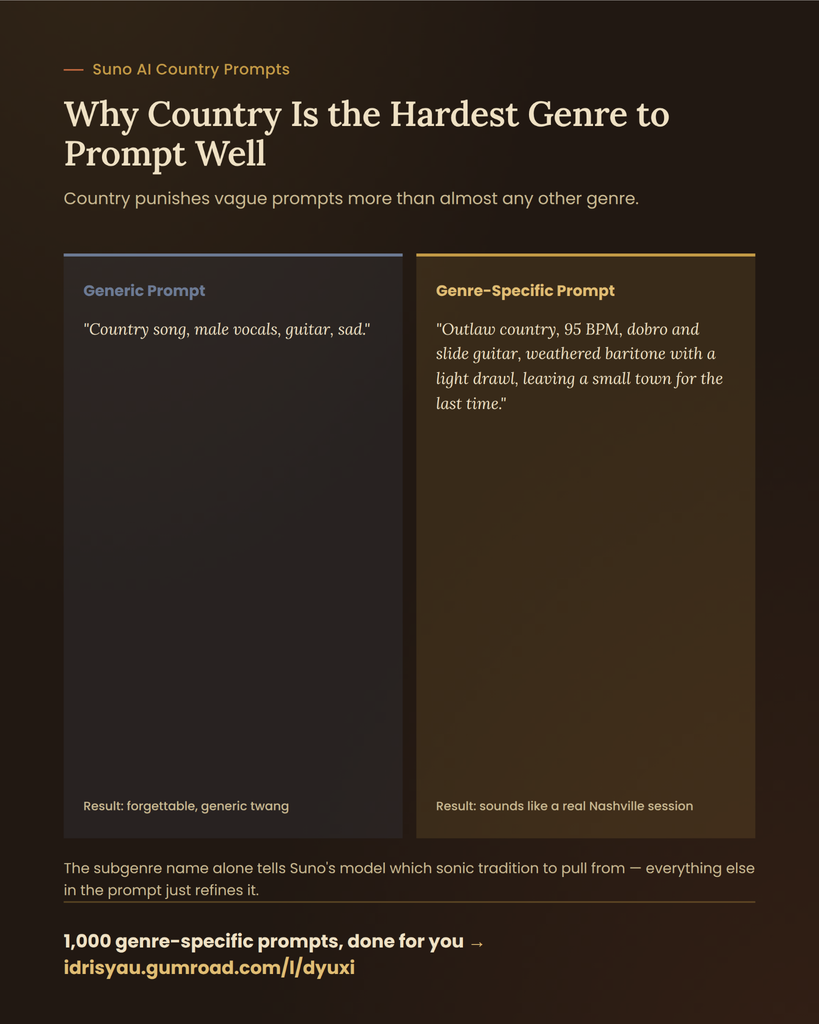
Most genres forgive vague prompts. Lo-fi hip-hop, ambient, ChillWave — say “moody” and “atmospheric” and Suno mostly gets there. Country punishes vagueness. As Britannica notes in its overview of the genre, country music grew out of specific regional folk traditions — Appalachian ballads, Western swing, honky-tonk bar bands — each with its own instrumentation, tempo, and vocal delivery. A model trained on all of that at once will default to the blandest common denominator unless you narrow it down.
That’s why “country song, male vocals, guitar” produces something forgettable, while a prompt naming the actual subgenre, the instrumentation, the vocal character, and the story angle produces something that sounds like it was mixed in a real studio. The subgenre name alone does a huge amount of work, because it tells Suno’s model which sonic tradition to pull from.
The Five-Part Formula Behind Every Strong Country Prompt
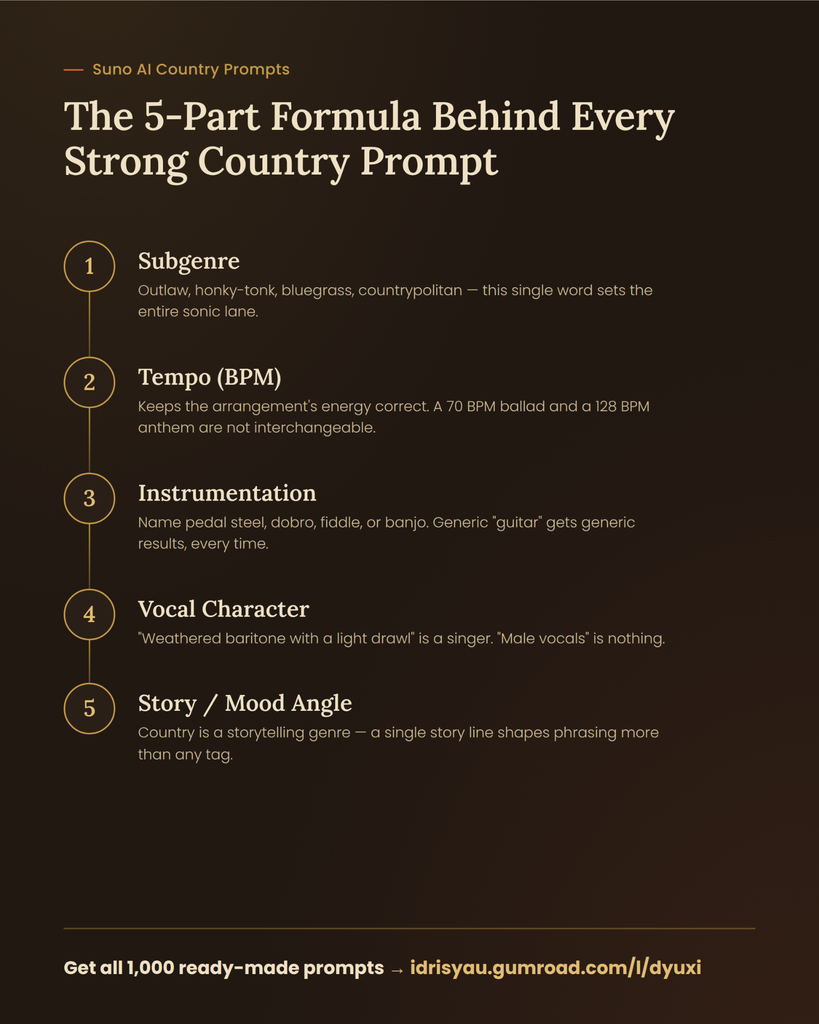
Every prompt in a well-built country pack follows roughly the same structure, whether it’s outlaw country or countrypolitan:
Subgenre + tempo (BPM) + instrumentation + vocal character + story or mood angle.
Here’s what each part is doing:
- Subgenre sets the sonic lane — this is the single highest-leverage word in the whole prompt.
- Tempo keeps the arrangement from drifting into the wrong energy. A 70 BPM outlaw ballad and a 128 BPM bro-country anthem are not interchangeable.
- Instrumentation is where country lives or dies. Naming pedal steel, dobro, fiddle, banjo, or a Telecaret twang tells Suno exactly what texture to reach for. Leave it generic and you get generic.
- Vocal character turns “male vocals” into an actual singer. A “weathered baritone with a slight drawl” is a completely different performance than “bright, polished tenor.”
- Story or mood angle is what separates a demo from a song. Country is a storytelling genre — a phrase like “leaving a small town for the last time” shapes phrasing and melody more than any technical tag could.
A skeletal example of the formula in action looks something like this:
[Subgenre], [BPM], [named instrument 1] and [named instrument 2], [vocal descriptor], [story/mood line]
That’s the shape. Filling in twenty subgenres’ worth of accurate instrumentation, tempo ranges, and vocal descriptors by hand is the slow part — which is exactly what the full prompt pack does for you across all 1,000 entries.
The 20 Genre-Accurate Country Subgenres You Should Actually Be Prompting
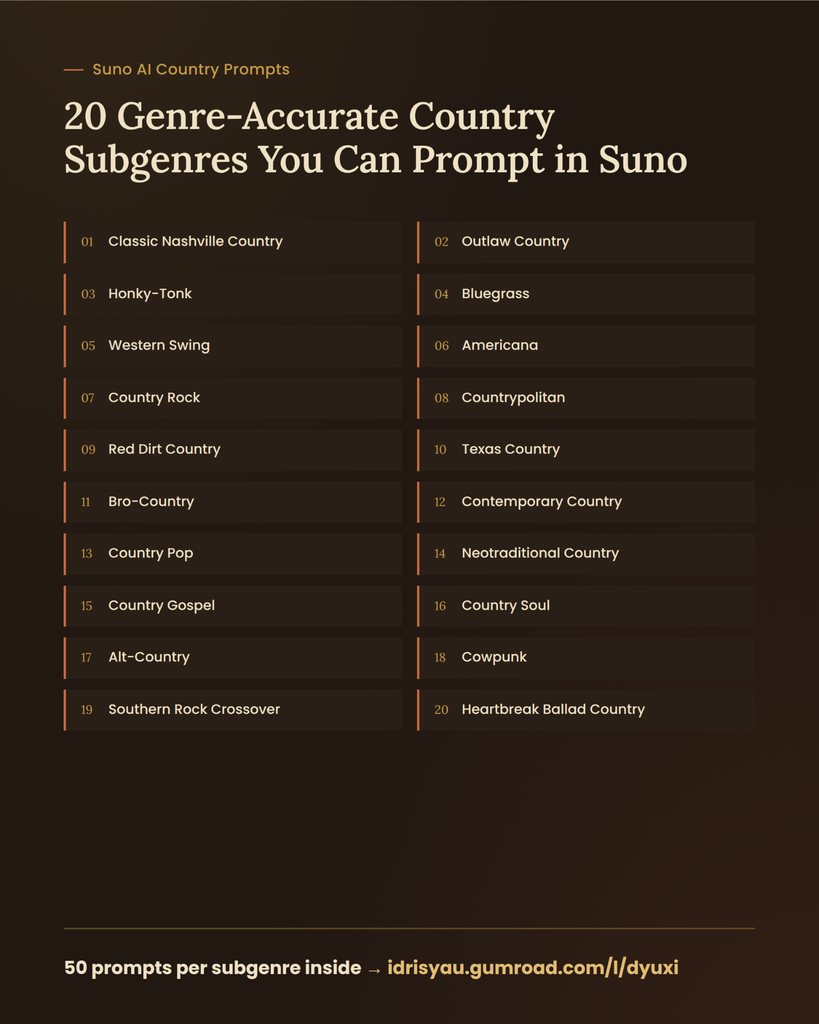
Most “Suno country prompts” lists online repeat the same five or six styles — modern country, outlaw, Americana — and stop there. Real country music, the kind organizations like the CMA represent and celebrate every year, spans a much wider range. Below are the 20 subgenres worth having dedicated prompts for, with a taste of what makes each one sonically distinct.
1. Classic Nashville Country — Polished mid-century arrangements, string sections, smooth vocal delivery, the “countrypolitan predecessor” sound of the 1950s-60s.
2. Outlaw Country — Gritty, defiant, minimal production, associated with artists who rejected the Nashville polish in favor of raw honesty.
3. Honky-Tonk — Barroom piano, walking bass, danceable shuffle rhythm, built for a crowded dance floor.
4. Bluegrass — Acoustic-only, breakneck picking on banjo and mandolin, tight vocal harmonies, no drum kit.
5. Western Swing — Big-band horns meeting steel guitar and fiddle, swing rhythm section underneath.
6. Americana — Folk-rock hybrid, understated production, literate lyrics, closer to singer-songwriter territory.
7. Country Rock — Electric guitar solos, driving drums, arena-scale energy layered over country roots.
8. Countrypolitan — Lush strings and background choirs, the most “pop” version of vintage country.
9. Red Dirt Country — Texas/Oklahoma regional scene, rougher edges than mainstream Nashville, community-venue energy.
10. Texas Country — Independent, radio-adjacent but not radio-dependent, dobro-heavy, dance-hall friendly.
11. Bro-Country — Modern radio country, trap-influenced drum programming, party lyrics, festival-scale hooks.
12. Contemporary Country — Current mainstream Nashville sound, blended pop production with traditional instrument accents.
13. Country Pop — Crossover-ready, synths and pop drum patterns layered under a country vocal twang.
14. Neotraditional Country — A conscious return to 80s/90s “real country” instrumentation as a reaction against pop-country.
15. Country Gospel — Choir-backed, reverent, built around harmony vocals and a worship arc.
16. Country Soul — R&B phrasing and horn sections fused with country storytelling and pedal steel.
17. Alt-Country — Indie-rock production values, unconventional song structures, understated vocal delivery.
18. Cowpunk — Fast, raw, distorted guitars over a country backbone — punk energy, country bones.
19. Southern Rock Crossover — Slide guitar solos, Southern-rock swagger, blues-rock chord progressions.
20. Heartbreak Ballad Country — Slow tempo, sparse arrangement, steel guitar cries, built entirely around a lyrical gut-punch.
Notice how different the instrumentation, tempo range, and vocal treatment are across just these twenty. That’s the entire argument for genre-specific prompting: one generic “country” prompt cannot cover this range, and most free prompt lists online only scratch two or three of these categories before running out of ideas.
Tempo Ranges by Subgenre (A Quick Reference)
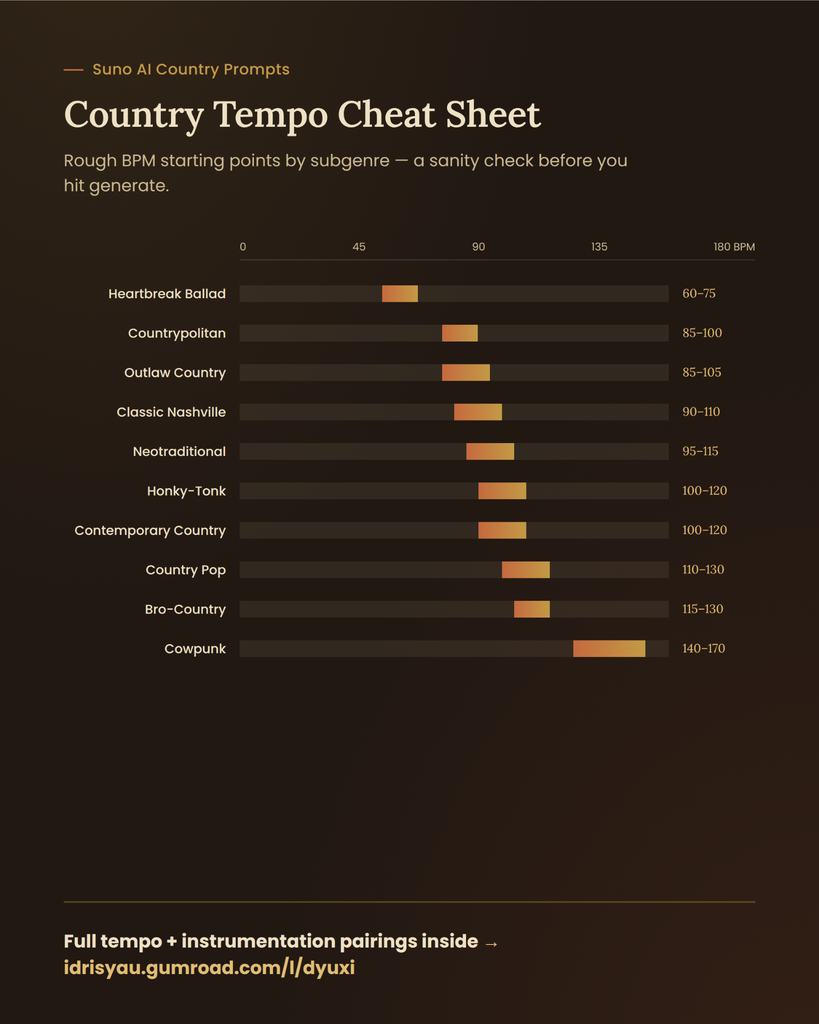
BPM is the part people guess at most, and guessing wrong is why a “ballad” prompt sometimes comes back sounding like a mid-tempo radio single. As a rough starting point:
| Subgenre | Typical BPM range | Feel |
|---|---|---|
| Heartbreak ballad | 60–75 | Sparse, slow-building |
| Bluegrass | 90–140 | Fast, tightly picked |
| Honky-tonk | 100–120 | Danceable shuffle |
| Outlaw country | 85–105 | Steady, gritty |
| Classic Nashville | 90–110 | Smooth mid-tempo |
| Countrypolitan | 85–100 | Lush, orchestral pacing |
| Neotraditional | 95–115 | Grounded, radio-ready |
| Contemporary country | 100–120 | Mainstream mid-tempo |
| Country pop | 110–130 | Bright, hook-driven |
| Bro-country | 115–130 | Festival energy |
| Country rock | 115–135 | Driving, guitar-forward |
| Southern rock crossover | 100–125 | Groove-heavy |
| Cowpunk | 140–170 | Fast, raw |
These ranges aren’t rigid rules — they’re a sanity check. If a prompt for a heartbreak ballad comes back at 130 BPM, the tempo number in the prompt is doing the opposite of what the rest of the language is asking for.
How to Use These Prompts Once You Have Them
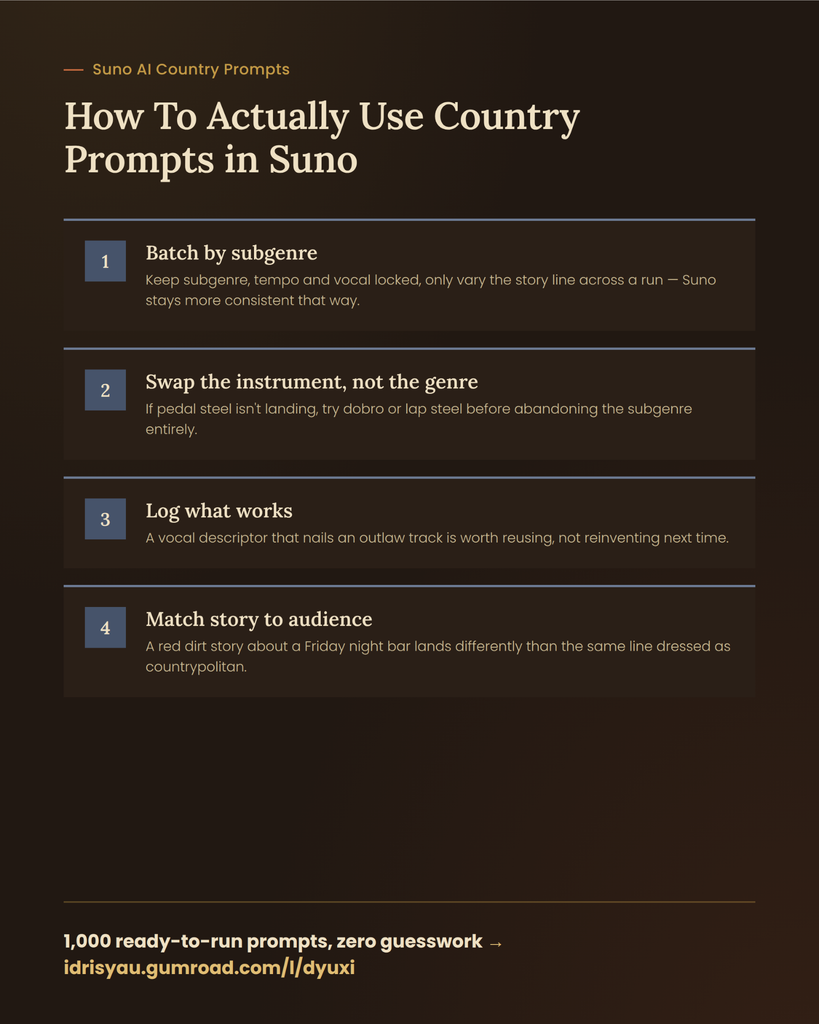
A prompt is only half the workflow. A few habits make the difference between a folder of forgettable clips and a batch of usable tracks:
- Generate in small batches per subgenre, not one giant mixed batch. Suno’s model responds more consistently when the subgenre, tempo, and vocal descriptor stay locked while only the story angle changes across a run.
- Keep a shortlist of instrumentation swaps. If a pedal-steel-heavy prompt isn’t landing, try dobro or lap steel instead before abandoning the subgenre entirely — small instrumentation swaps often fix a track that “almost” works.
- Log what works. Country in particular rewards iteration; a vocal descriptor that nails a great outlaw track this week is worth reusing, not reinventing from scratch next time.
- Match the story angle to the subgenre’s audience. A red dirt or Texas country prompt about small-venue Friday nights will land differently than the same story angle applied to countrypolitan, which leans more polished and radio-oriented.
Common Mistakes That Make AI Country Sound Fake
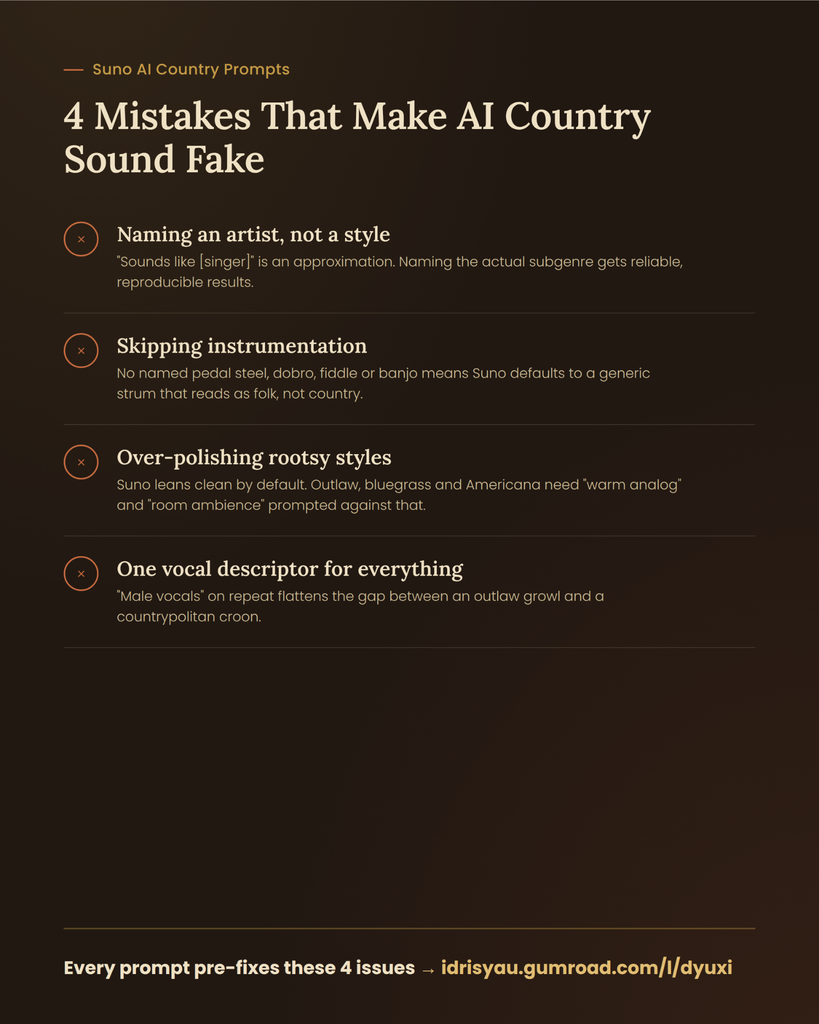
Naming an artist instead of a style. “Sounds like [famous singer]” gets you an approximation at best and can trigger inconsistent results. Naming the actual subgenre and vocal character gets you a more reliable, reproducible result.
Skipping instrumentation entirely. This is the single biggest gap between amateur and professional-sounding country prompts. If you don’t name pedal steel, dobro, fiddle, or banjo specifically, Suno tends to default to a generic acoustic guitar strum that reads as folk, not country.
Over-polishing production language. For rootsier subgenres like outlaw country, bluegrass, or Americana, asking for “warm analog,” “room ambience,” or “live-off-the-floor” production keeps the track from sounding gridded and sterile. Suno’s default leans clean — you often have to prompt against that for authenticity.
One vocal descriptor for every song. “Male vocals” repeated across fifty generations gets monotonous fast, and it flattens the difference between an outlaw growl and a countrypolitan croon. Vary the descriptor by subgenre.
Beyond Country: Prompting Other Genres the Same Way
The five-part formula above — subgenre, tempo, instrumentation, vocal character, story angle — isn’t unique to country. It’s the same structure that makes prompts work across any genre with strong regional identity. If you’re also experimenting outside country, the same logic applies to K-pop-style Suno prompts, Christian and worship music prompts, and Brazilian phonk prompts — each genre just swaps in its own instrumentation and vocal vocabulary.
What’s Actually Inside the 1,000-Prompt Country Pack
Everything above is the framework. Building out accurate tempo ranges, real instrumentation combinations, and varied vocal descriptors across all 20 subgenres — at a volume large enough that you’re never recycling the same prompt twice — is the part that takes real time. That’s what the 1,000 Suno AI Country Music Prompts pack is built to solve.
Inside, you get:
- 1,000 fully written, copy-paste-ready prompts, roughly 50 per subgenre across all 20 categories listed above
- Genre-accurate instrumentation and tempo pairings so every prompt sounds like it belongs in that subgenre, not a generic approximation of it
- Varied vocal character descriptors so your tracks don’t all sound like the same singer
- A structure built specifically around how Suno’s current models respond to country-specific language
If you generate country tracks regularly — for a YouTube channel, a playlist project, songwriting practice, or just for fun — this pack removes the slowest part of the process: sitting there trying to remember what makes Western swing different from red dirt country at 11pm.
Get the 1,000 Suno AI Country Music Prompts pack here →
Frequently Asked Questions
What’s the best Suno prompt format for country music? The most reliable structure is subgenre, tempo (BPM), named instrumentation, vocal character, and a short story or mood angle, in that order. Leading with the subgenre name gives Suno the clearest signal about which sonic tradition to pull from.
Why does my Suno country track sound generic? Almost always because the instrumentation wasn’t named specifically. “Guitar” reads as generic; “pedal steel and dobro” reads as country. The second biggest cause is a vague vocal descriptor like “male vocals” instead of a character like “weathered baritone with a light drawl.”
How many country subgenres does Suno actually support well? In practice, all 20 covered in this guide generate distinctly when prompted correctly. The subgenres with the most sonic overlap — like contemporary country and country pop, or Texas country and red dirt — need the most specific instrumentation cues to stay distinguishable.
Is the 1,000-prompt pack only for Suno, or does it work on other AI music tools? The prompts are written and tested for Suno specifically, but the underlying instrumentation and vocal language transfers reasonably well to other text-to-music tools, since the descriptive vocabulary (pedal steel, honky-tonk shuffle, outlaw baritone) isn’t platform-specific.
Do I need to know music theory to use these prompts? No. Every prompt in the pack is written in plain descriptive language — BPM numbers are provided, but you don’t need to understand keys, chord progressions, or theory to use any of them effectively.
Get the Full Pack
If you’ve read this far, you already understand why generic country prompts underperform and specific ones don’t. The framework in this guide will improve your results immediately — the full 1,000-prompt pack just saves you from having to write all twenty subgenres’ worth of accurate, varied prompts yourself.
Download the 1,000 Suno AI Country Music Prompts pack now →
1,000 Suno AI Country Prompts — 20 Genre-Accurate Subgenres Copy & paste pack. Instant PDF download.
Get the Pack →