If you have type “reggaeton bear” or “salsa song” into and gotten back something that sounds vaguely tropical but nothing like the real thing, you are not alone. Latin music is one of the hardest categories to prompt well not because the genres are obscure but because they are incredibly unique. Bachata and merengue both come from the Dominican Republic, both features Spanish vocals, and both will turn into generic “world music” mush if your prompt doesn’t nail the instrumentation, rhythm, and vocal delivery that separate one from the other.
This guide breaks down exactly how to write Latin prompts for Suno AI that actually produce reggaeton, salsa, bachata, cumbia, and more-the way those genres actually sound not the way an AI guesses they sound. By the end of this guide, you will understand the structure behind great Latin prompt. And if you want the fastest way to skip the trial and error entirely, the 1,000 Latin Music Prompts for Suno AI pack gives you copy-paste-ready prompts across reggaeton, salsa, bachata, and 15 more genres, so you are never starting from a blank page.
Why Latin Music Genres Are So Easy to Get Wrong in Suno
Latin music isn’t one genre – it’s an umbrella term the music industry uses for distinct styles that share a language (Spanish and Portuguese) and a broad cultural region, but sound nothing alike. In the US, Latin Music’s roots trace back to 1930s rhumba, and the style didn’t fully weave into mainstream American culture until the 1950s and 60s. The label has stretched to cover everything from Andean flute to reggaeton, which is part why AI music tools default to a generic “Latin” sound when your prompt doesn’t specify a genre precisely enough.
🔥 1,000 Latin Music Prompts for Suno AI — Reggaeton, Salsa, Bachata & 15 more 🔥 1,000 Latin Prompts
Get the Pack →The good news is that once you understand the defining instrumentation and rhythm of each genre, Suno responds well to specificity. A general breakdown of the most recognizable styles — including bachata, reggaeton, salsa, cumbia, merengue, dembow, bomba, son, cha-cha-cha, and guaguancó — is covered well in this overview of Latin American music genres, which is a solid reference if you want to understand the roots before you start prompting. Institutions like Carnegie Hall have also spent entire festival seasons unpacking how genres like bolero, bossa nova, and cha-cha-cha each carry their own instrumentation and history — useful context if you want your prompts to reflect real musical DNA instead of a caricature.
The Anatomy of a Great Latin Suno Prompt
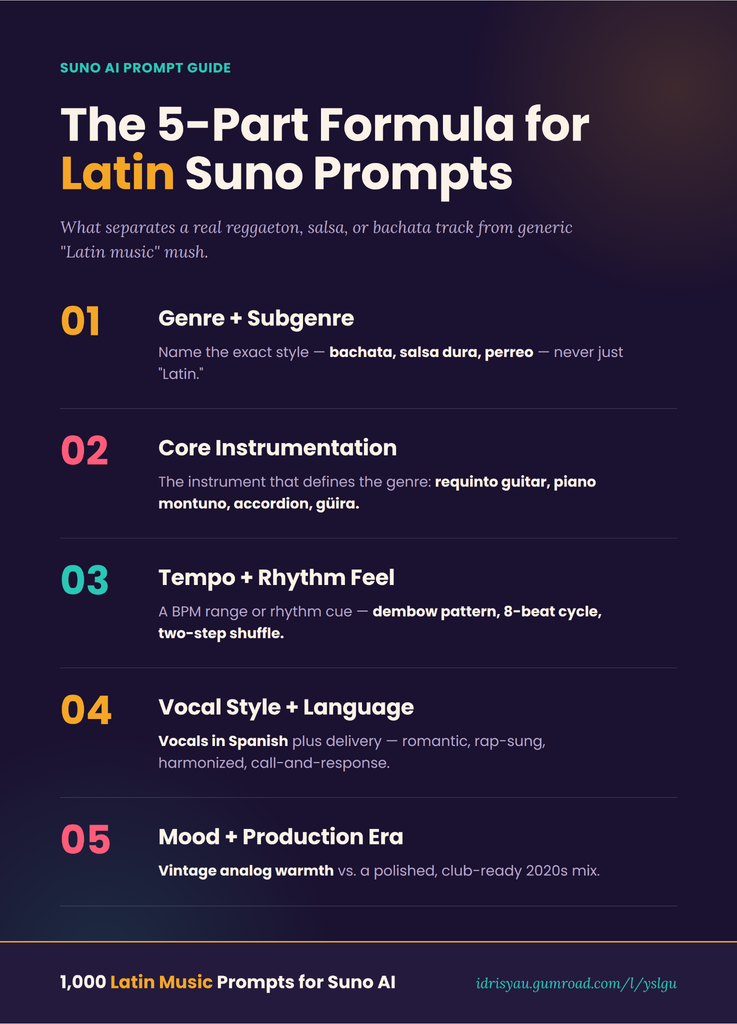
Every strong Latin prompt for Suno has five components. Skip one, and the model fills in the gap with a guess — and its guesses tend to default toward the most commercially visible Latin sound (usually reggaeton or Latin pop), even when you asked for something else.
- Genre + subgenre — “bachata,” not just “Latin.” If it’s a modern hybrid, say so: “urban bachata” or “bachata sensual.”
- Core instrumentation — the specific instruments that define the genre. Salsa needs congas, timbales, and piano montunos. Bachata needs the requinto guitar riff. Cumbia needs the accordion or gaita and the characteristic güira/guacharaca scrape.
- Tempo and rhythm feel — BPM range or a rhythm description (“syncopated two-step,” “8-beat bachata cycle,” “up-tempo cumbia shuffle”).
- Vocal style and language — Spanish male lead, dual harmony vocals, romantic delivery, aggressive dembow flow, etc.
- Mood and production era — romantic and nostalgic vs. club-ready and modern, plus whether you want a vintage analog feel or a polished 2020s mix.
Show Image
Here’s a skeletal example so you can see the shape (the full, genre-specific, paste-ready versions — dialed in for Suno’s actual tag syntax — are what’s inside the prompt pack):
[Genre] with [core instruments], [tempo/rhythm feel], [vocal style] vocals in Spanish, [mood/theme], [production era] mixThat’s the framework. Now let’s apply it across the genres people search for most.
Reggaeton Prompts for Suno AI
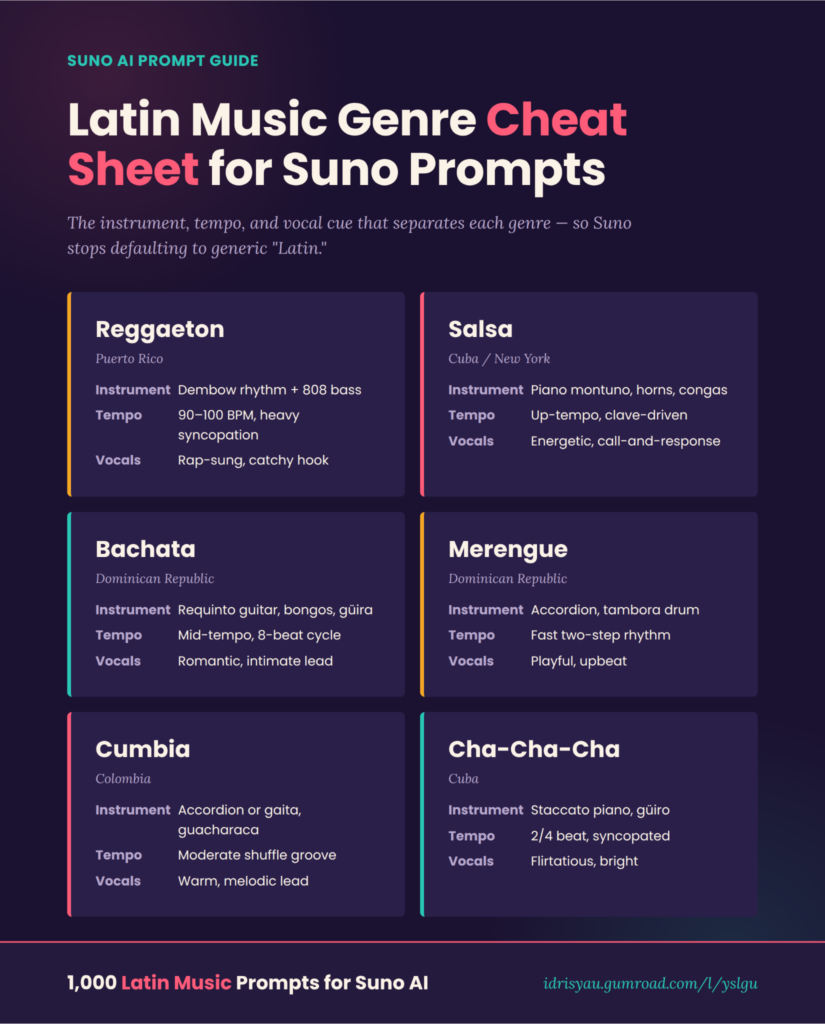
Reggaeton is the genre most people mean when they say “Latin music” today, and it’s also the one Suno defaults toward if your prompt is vague. To get an authentic result, your prompt needs the dembow rhythm pattern explicitly named, since that’s the actual rhythmic backbone of the genre — a heavy, syncopated drum pattern originally popularized through Dominican dembow and carried into mainstream reggaeton. Layer in a catchy melodic hook, a fast-paced rap-sung vocal delivery, and modern trap-influenced 808s if you’re going for a 2020s sound, or a more stripped-down beat if you want the early-2000s “Gasolina” era.
A skeletal starting point:
Reggaeton with dembow rhythm, heavy 808 bass, [tempo] BPM, catchy hook, [male/female] vocals in Spanish, club-ready mixThe full pack includes dozens of reggaeton variations — perreo, reggaeton romántico, old-school dembow, and trap-fused reggaeton — each with instrumentation and vocal tags already dialed in.
Want the 100+ reggaeton prompts already written for you? Grab the full pack here →
Salsa Prompts for Suno AI
Salsa is unforgiving in Suno because it depends on interlocking instrumental parts, not just a vibe. You need the piano montuno (that repeating syncopated piano pattern), a horn section for the punchy brass stabs, congas and timbales driving the percussion, and a clave rhythm underneath everything. Miss the horns or the montuno and Suno will often hand you something closer to generic Afro-Cuban jazz instead of salsa.
Skeletal example:
Salsa with piano montuno, horn section stabs, congas and timbales, clave rhythm, energetic male vocals in Spanish, dance-floor mixIf you want romantic, slower salsa (the salsa romántica sound from the 1980s and 90s), say so explicitly and drop the tempo — otherwise Suno will default to the faster, brass-forward classic style.
The pack includes classic salsa, salsa romántica, and salsa dura variations, all fully written. See the full Latin prompt pack →
Bachata Prompts for Suno AI
Bachata is one of the most requested — and most botched — genres in Suno because people confuse it with merengue or general “romantic Latin” music. The defining element is the requinto guitar: a bright, melodic lead guitar line playing over a bass guitar, bongos, and güira. The genre is traditionally slow and romantic, built on an 8-beat cycle, though modern “bachata urbana” versions blend in R&B and pop production.
Skeletal example:
Bachata with requinto guitar lead, bass guitar, bongos, güira, romantic male vocals in Spanish, mid-tempo, intimate mixFor modern bachata sensual or urban bachata, add a smoother, more R&B-leaning production style and slower tempo — the pack has both traditional and modern variants ready to go.
Skip the guesswork on requinto tags and tempo ranges — the full bachata prompt set is inside the pack.
Merengue, Cumbia, and Tropical Genre Prompts
Merengue and cumbia both fall under “tropical music,” but they need completely different instrumentation. Merengue relies on the accordion, tambora drum, güira, and a fast two-step rhythm, and it tends to carry a playful, upbeat lyrical tone. Cumbia, which originated in Colombia, is built around large drumming ensembles, wind and string instruments, and a guitar-led main melody, and its rhythm and instrumentation shift depending on whether it leans more Caribbean, African-influenced, or traditional Andean.
Because these genres are rhythmically similar to some Afro-Brazilian styles, it’s worth comparing how percussion-driven fusion genres get prompted elsewhere — the same instrument-first approach used in our Brazilian phonk prompt guide applies well to layering Latin percussion with modern trap or bass elements if you’re chasing a fusion sound rather than a purebred genre.
Merengue, cumbia, vallenato, and tejano prompts are all fully written out inside the 1,000 Latin Music Prompts pack — no need to piece together instrumentation from scratch.
Latin Pop, Latin Trap, and Cross-Genre Fusions
Not every search is for a traditional genre. A huge share of Latin prompt traffic is people trying to build modern fusion sounds — Latin trap, Latin pop-EDM crossovers, or genre-blending tracks influenced by global pop movements. The same specificity rules apply: name the base genre, name the fusion element, and describe how they interact (e.g., “reggaeton foundation with trap hi-hats and Auto-Tuned vocals” rather than just “Latin trap”).
If you’re experimenting with cross-cultural fusion prompts more broadly — blending Latin rhythms with other global pop sounds — the same prompt logic that works for K-pop-style Suno prompts (layering a specific regional sound with modern pop production tags) transfers directly to Latin fusion work.
Latin worship and gospel music is another underserved niche — Spanish-language praise and worship tracks with bolero or bachata influences are increasingly common, and if that’s your focus, our Suno AI Prompt Guide for Christian Music covers the vocal and production tags that translate well into Latin gospel prompting.
Latin trap, Latin pop, and fusion prompts are covered too — the full pack has you covered whether you’re going traditional or experimental.
Son, Bomba, and Cha-Cha-Cha Prompts for Suno
A few more genres worth having in your back pocket, since they show up constantly in Latin-fusion and retro-style requests:
Son is the Cuban root style behind salsa — Spanish guitar (the tres), African-influenced drum patterns, and layered vocal harmonies. Prompt it with “Cuban son, tres guitar, layered vocal harmony, mid-tempo, warm analog mix” for a vintage feel closer to pre-salsa Cuban recordings.
Bomba, from Puerto Rico, is built almost entirely around percussion — barriles (drums), call-and-response vocals, and a fast, driving tempo. It’s a good choice when you want something rhythm-forward with minimal melodic instrumentation.
Cha-cha-cha has a distinct 2/4 beat with staccato, syncopated rhythms, and works well for anything flirtatious, upbeat, or dance-floor nostalgic. Naming the tempo and the “staccato rhythm section” in your prompt keeps Suno from drifting into generic salsa territory.
Each of these genres has its own instrumentation quirks that are easy to miss if you’re not already familiar with the tradition — which is exactly the kind of detail the full prompt pack handles for you, genre by genre.
Son, bomba, cha-cha-cha, bolero, and bossa nova prompts are all included — check out the full pack →
Show Image
Common Mistakes People Make Prompting Latin Music in Suno
- Using “Latin” as the only genre tag. It’s too broad — Suno needs a specific style (bachata, salsa, cumbia, reggaeton) to lock onto the right rhythm and instrumentation.
- Forgetting the signature instrument. Every Latin genre has at least one instrument that defines it — the requinto in bachata, the montuno piano in salsa, the accordion in cumbia and vallenato. Leave it out, and the genre identity disappears.
- Ignoring vocal language and delivery. Specifying “vocals in Spanish” with a delivery style (romantic, rap-sung, harmonized) makes a measurable difference in output quality.
- Not specifying era or production style. “Modern” vs. “vintage” or “romántica-era” changes the entire mix, especially for salsa and bachata.
- Overloading one prompt with too many genres. Blending five Latin styles into one prompt usually produces a muddier result than committing to one primary genre with a secondary influence.
Avoiding these mistakes is the difference between a track that sounds like a rough draft and one that sounds radio-ready. If you’d rather not troubleshoot each genre yourself, every prompt in the pack already accounts for these pitfalls.
Why the Full Prompt Pack Saves You Hours
Writing one good Latin prompt takes some trial and error. Writing 1,000 of them — correctly tagged, genre-accurate, and ready to paste straight into Suno — is a different job entirely. That’s exactly what 1,000 Latin Music Prompts for Suno AI — Reggaeton, Salsa, Bachata & 15 More Genres is built for.
Inside, you’ll get fully written, paste-ready prompts (not just the skeletal frameworks shown above) across reggaeton, salsa, bachata, cumbia, merengue, dembow, bomba, son, cha-cha-cha, vallenato, tejano, Latin trap, Latin pop, bolero, bossa nova, and more — each one structured with the correct instrumentation, tempo, and vocal tags Suno actually responds to. If you make Latin music content, cover songs, playlists, or just want a fast way to generate authentic-sounding tracks without guessing, this is the shortcut.
Get the full 1,000 Latin Music Prompts pack →
FAQ: Latin Prompts for Suno AI
What’s the best way to prompt reggaeton in Suno? Name the dembow rhythm explicitly, specify 808 bass, a tempo range, and a rap-sung Spanish vocal delivery. Vague prompts like “reggaeton song” tend to produce generic tropical pop instead.
Can Suno generate authentic salsa music? Yes, but only with the right instrumentation named in the prompt — piano montuno, horn section, congas, timbales, and clave rhythm. Without those, Suno often defaults to generic Afro-Cuban jazz.
What’s the difference between bachata and merengue prompts? Bachata prompts should center on the requinto guitar, bongos, and a slower 8-beat romantic feel. Merengue prompts should center on the accordion, tambora drum, and a fast two-step rhythm. They’re often confused because both originated in the Dominican Republic.
Do I need to write prompts in Spanish for Suno to generate Spanish vocals? No — you can write your prompt in English and simply specify “vocals in Spanish” along with the delivery style you want.
How many genres are covered in the Latin prompt pack? The pack covers 18 genres total, including reggaeton, salsa, bachata, cumbia, merengue, dembow, bomba, son, cha-cha-cha, vallenato, tejano, Latin trap, Latin pop, bolero, and bossa nova, with 1,000 total prompts.
Where can I get the full set of prompts? You can grab the complete pack here: 1,000 Latin Music Prompts for Suno AI — instant download, paste directly into Suno.