If you’ve typed “Bollywood music prompt” into Suno and gotten back a generic pop-rock track with a sitar sample slapped on top, you already know the problem. Suno is one of the best AI music generators on the market, but it doesn’t know the difference between a dholak and a tabla, or why a qawwali needs harmonium drones instead of synth pads, unless your prompt tells it exactly what to do.
That gap between “I want Indian music” and “I got Indian music” is exactly what a well-built prompt library closes. Below, you’ll find the structure behind writing Suno AI prompts for Indian music that actually sound Indian — and where to get 500 of them already written, tested, and ready to paste in, in our 500 Suno AI Prompts for Indian Music ebook.
Why Everyone Is Suddenly Searching for AI Music Prompts
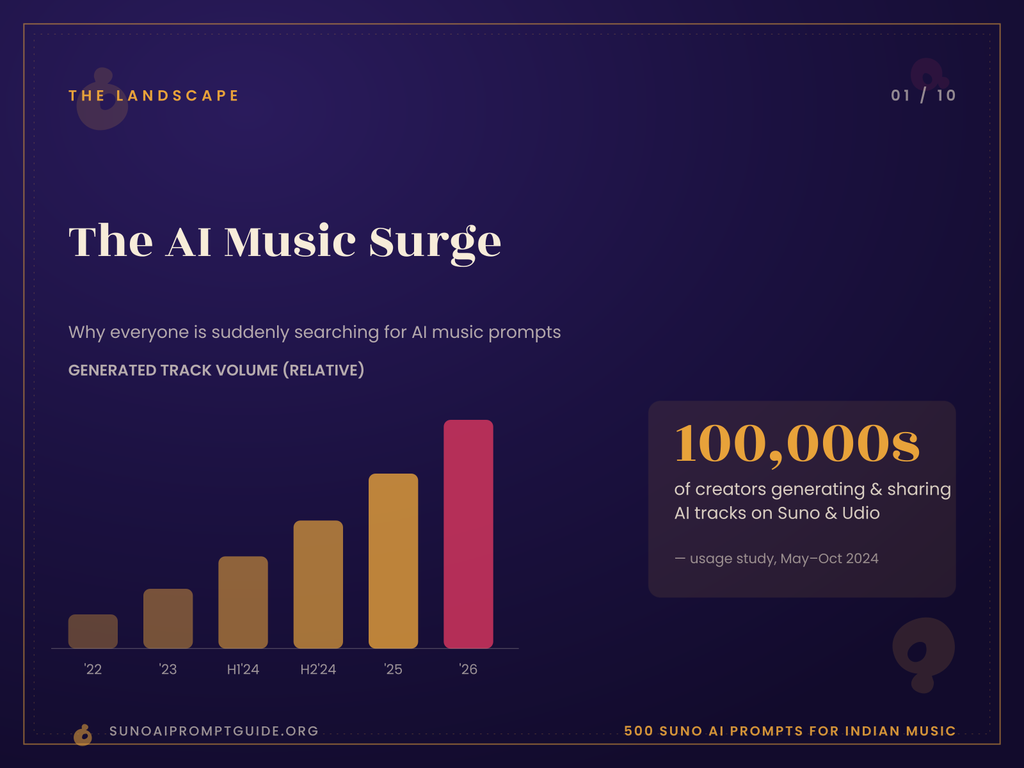
AI-generated music has moved from novelty to genuine cultural force in under two years. Researchers studying Suno and Udio usage between May and October 2024 found that hundreds of thousands of users were actively generating and sharing tracks across genres, with clear patterns in the language, tags, and themes people reached for when prompting the model. Indian music — spanning Bollywood, Bhangra, Carnatic and Hindustani classical, and countless regional fusion styles — sits right in the middle of that surge, because it’s one of the richest, most texturally distinct traditions in the world to prompt for.
That distinctiveness has always been part of Indian music’s global pull. A widely cited academic overview of Indian music’s globalisation traces how figures like Pandit Ravi Shankar carried Hindustani classical music to Western audiences from the 1950s onward, while composers like A.R. Rahman later pushed Bollywood scoring into Hollywood. The same overview notes that the West itself has become an active consumer of Bollywood music, not just an audience for classical crossover — which is exactly the appetite AI music tools are now feeding on a much larger scale.
Academic interest in AI-composed music is catching up fast too. A dataset project built specifically around Suno-generated songs, using human-made musical descriptions as prompts, demonstrated just how directly prompt wording shapes the emotional and structural outcome of a generated track — reinforcing that the prompt itself, not the platform, is what determines whether your song sounds authentic or generic.
This is the entire premise behind our ebook: give you 500 pre-engineered prompts so you skip months of trial and error. Grab it here for instant download.
What Actually Makes a Bollywood Music Prompt Work
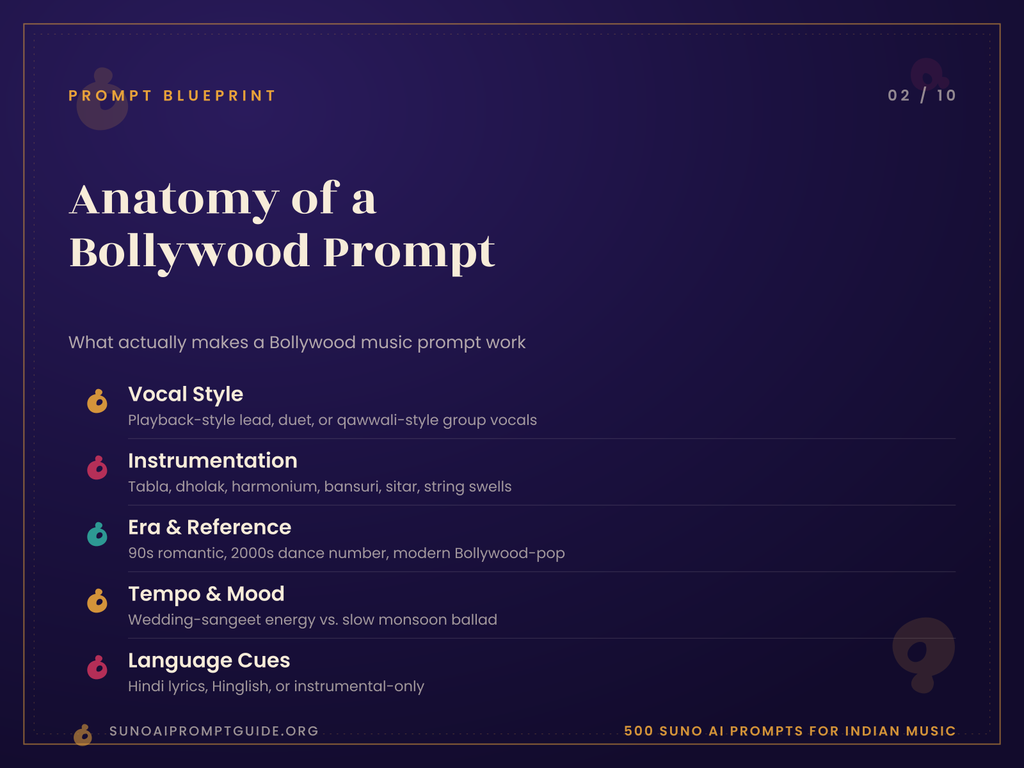
A strong Bollywood music prompt isn’t a vibe description — it’s a production brief. Suno responds best when you specify:
- Vocal style — playback-style female lead, dual male/female duet, qawwali-style group vocals
- Instrumentation — tabla, dholak, harmonium, bansuri, sitar, string orchestra swells
- Era and reference feel — 90s Bollywood romantic, 2000s dance number, contemporary Bollywood-pop crossover
- Tempo and mood — upbeat wedding-sangeet energy vs. slow monsoon ballad
- Language cues — Hindi lyrics, Hinglish, or instrumental-only
A prompt like “energetic Bollywood dance track, dhol and dholak rhythm, female playback vocals, festive wedding sangeet energy, brass stabs, 128 BPM” will consistently outperform “Indian pop song” by a wide margin. That specificity is the difference between a track you’d actually use and one you regenerate five times and give up on.
If you want the Hindi-language-specific version of this framework — including prompts written for Hindi lyric generation rather than just Hindi-flavored instrumentation — we’ve broken it down separately here: Suno AI Prompts for Indian Music in Hindi.
Finding the Best Hindi AI Music Generator (And Why the Prompt Still Matters More)
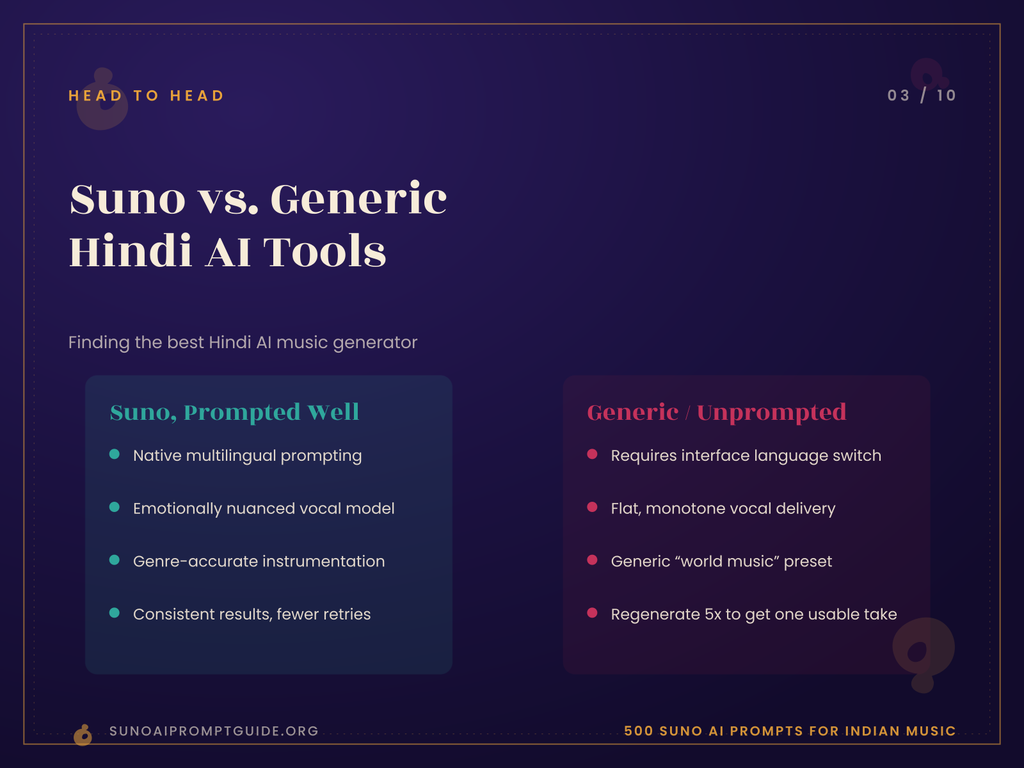
People searching for the best Hindi AI music generator are usually comparing Suno against Udio, Boomy, or similar tools. Suno tends to win that comparison for Indian music specifically because it handles multilingual prompting natively — you don’t need to switch the entire interface to Hindi, and its vocal model has gotten noticeably better at emotional nuance and language-accurate phrasing since its more recent version updates.
But here’s the part most comparison articles skip: even the best generator produces mediocre results with a lazy prompt. Suno’s own documentation and independent guides consistently emphasize that a prompt functions as a production brief, not a poetic description — genre, tempo, emotional register, and instrumental texture are what actually move the needle, and vague language like “beautiful music” produces nothing usable. That’s precisely why a tested prompt library outperforms freestyling one-off ideas, especially across dozens of Indian sub-genres you may not have deep production vocabulary for.
Our ebook does that vocabulary work for you — every prompt is already structured with the genre, instrumentation, and tempo cues that get consistent, usable results. See what’s inside and download instantly.
AI-Generated Hindi Songs Aren’t Just a Novelty Anymore
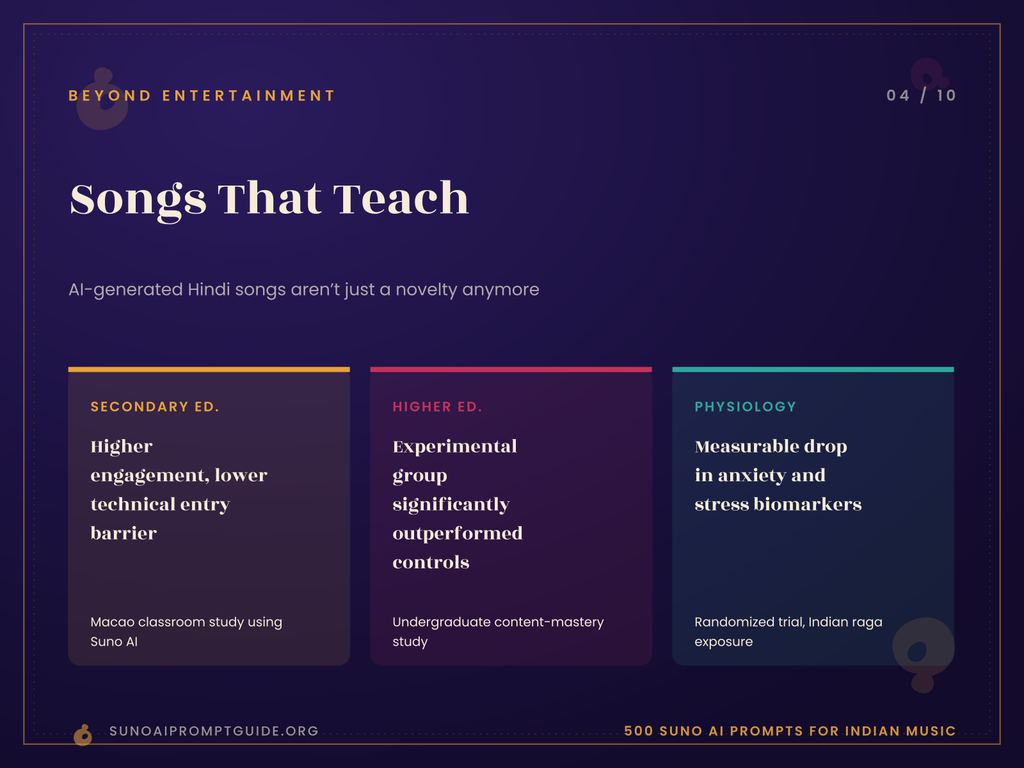
There’s a growing body of research looking at what AI-generated Hindi and Indian-language songs are actually good for beyond entertainment. A study on secondary music education in Macao found that teachers using Suno AI with students reported higher engagement, lower technical entry barriers, and stronger differentiation by genre and language when students generated their own songs as part of coursework. A separate experimental study on undergraduate students found that groups taught academic content through AI-generated songs significantly outperformed a control group taught through conventional methods.
Beyond education, there’s even physiological evidence for why Indian music specifically resonates so deeply. A randomized controlled trial on Indian music as an auditory stimulus found that specific ragas measurably reduced state anxiety and shifted cardiovascular markers in healthy young adults — a reminder that the emotional weight behind Bollywood, classical, and devotional prompts isn’t just aesthetic, it’s rooted in centuries of deliberate musical design.
That’s a meaningful signal for anyone building content, marketing, or teaching material in Hindi: ai generated hindi songs aren’t just for fun — they’re becoming a legitimate tool for memory, engagement, and cultural resonance, provided the prompt behind them is actually accurate to the genre and language you’re targeting.
Using Suno as a Random Hindi Song Generator (Without the Randomness Working Against You)
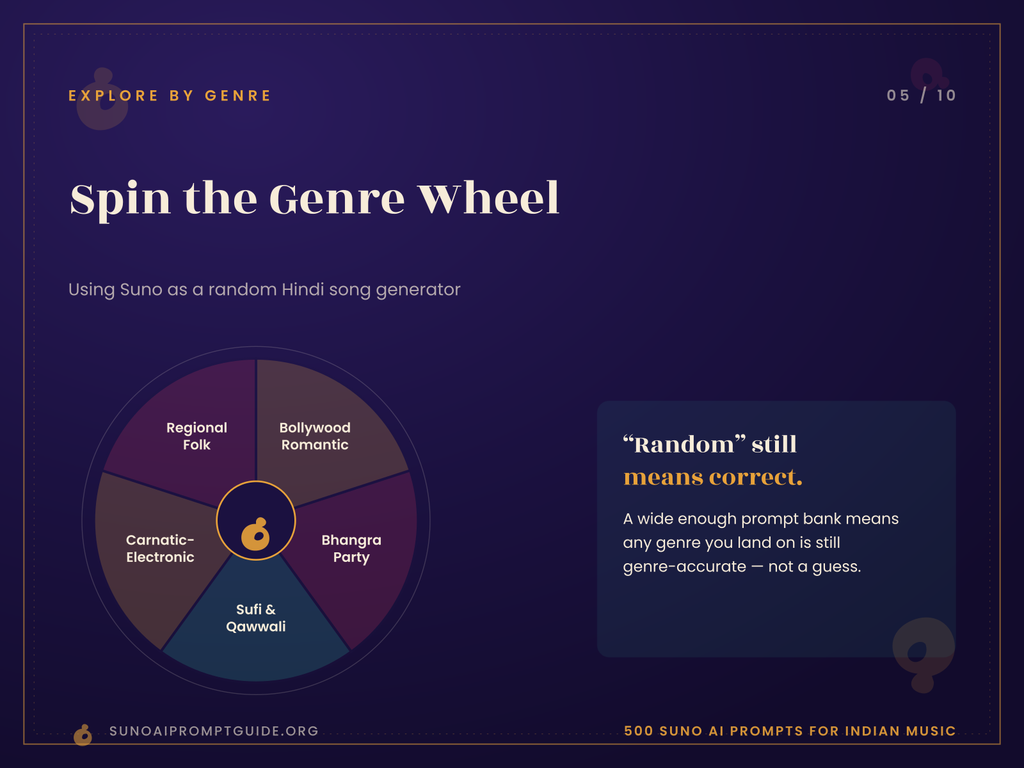
A lot of people come to Suno wanting something closer to a random hindi song generator — just hit generate and get something usable without deep production knowledge. That’s a completely reasonable way to use the tool, but “random” doesn’t have to mean “unpredictable quality.” The trick is having a wide enough bank of pre-built prompts across genres — Bollywood romantic, Bhangra party anthems, Sufi-qawwali fusion, Carnatic-electronic crossover — that you can pull one at random and still land on something genre-accurate every time.
That’s the exact use case our 500-prompt ebook was built for: enough breadth and variety that “random” still means “correct.” It also cross-references with our companion 3,000+ prompt mega-library for anyone who wants an even wider net across every genre Suno supports — browse it here.
Indian Music as a World Music Prompt Generator Category
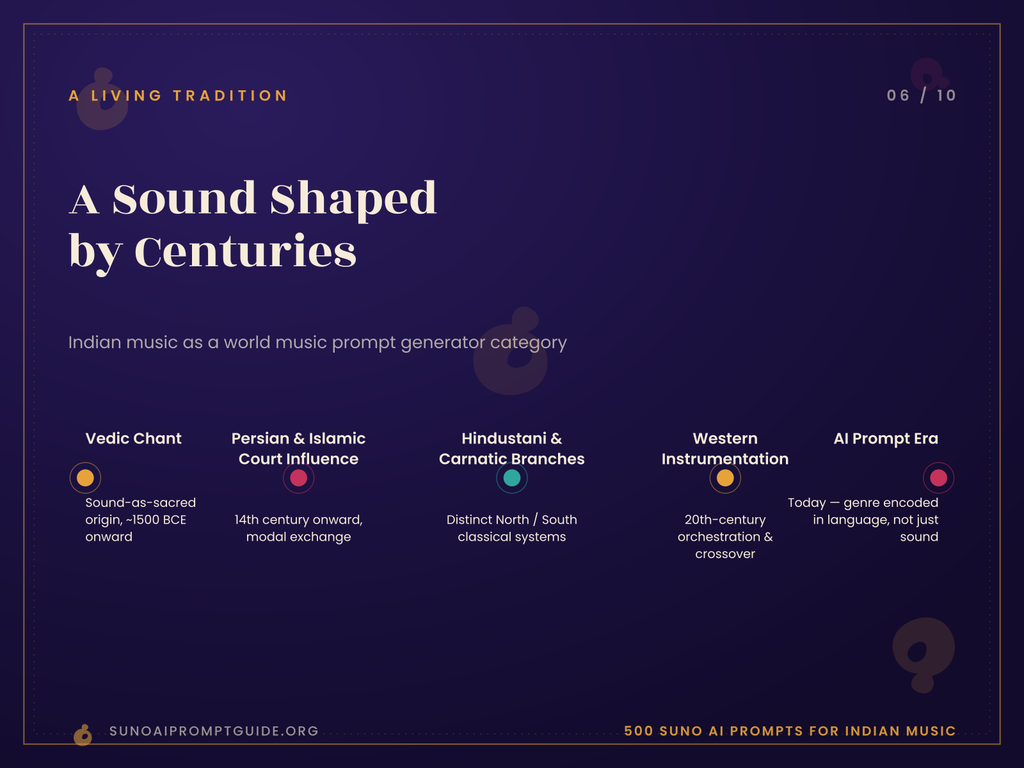
If you’re using Suno as a broader world music prompt generator, Indian music deserves its own dedicated prompt set rather than being lumped in as one line item under “world music.” The tradition itself is enormous — ethnomusicologist Daniel Neuman’s classic study, Indian Music as a Cultural System, describes it as one of the oldest continuous cultural systems in the world, shaped over centuries by Vedic chant, regional folk forms, Persian and Islamic court influence, and later Western instrumentation, producing distinct Hindustani and Carnatic classical branches alongside dozens of regional popular styles.
That depth is a gift for prompting, not a limitation — it means there are dozens of legitimately distinct sub-genres to explore: Bhangra, Rajasthani folk, Carnatic-classical fusion, Sufi-qawwali, Bollywood-EDM crossover, and more. It’s the same logic we’ve applied to other world music categories on this site, like our breakdowns for Brazilian phonk prompts and Suno AI K-pop prompts — each tradition needs its own vocabulary to prompt convincingly, and Indian music is no exception.
Building an Indian Singer AI Song Generator Workflow
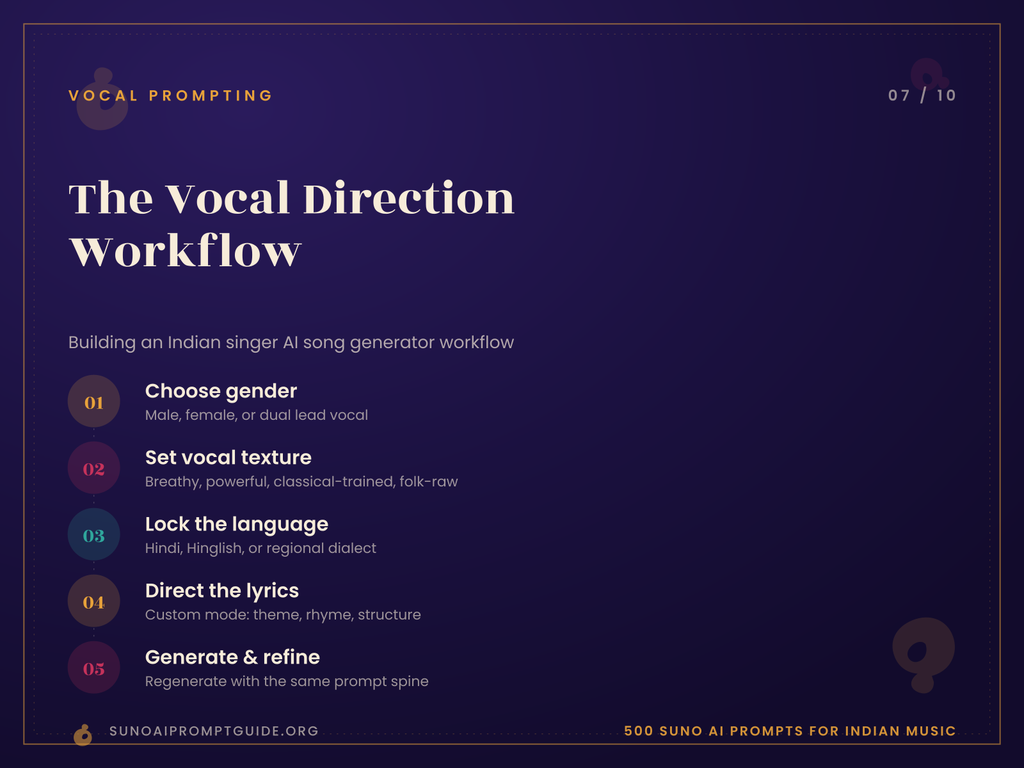
If your goal is specifically an indian singer ai song generator workflow — generating full vocal tracks with an Indian playback-style voice rather than instrumentals — vocal direction in your prompt matters even more than instrumentation. Specify gender, vocal texture (breathy, powerful, classical trained, folk-raw), and language directly in the prompt, and pair it with lyric direction if you’re using Suno’s custom mode.
Dataset research built specifically around Suno-generated tracks has shown that prompt-alignment — how closely the output matches the described vocal and instrumental intent — is something researchers can measure and annotate directly, which confirms what prompt engineers already suspected: the more precisely you describe the voice you want, the more reliably Suno delivers it. Our ebook includes dedicated vocal-direction language for exactly this reason, tuned specifically for Bollywood playback style, Bhangra lead vocals, and classical-influenced delivery.
Worth flagging while we’re on the topic of AI-generated vocals: as this space matures, questions of ownership and originality are actively being debated in legal scholarship, not just in the tech press. It’s a good reason to treat AI vocal generation as a creative tool for your own original songs rather than a shortcut to recreate someone else’s copyrighted performance.
What’s Inside the 500 Suno AI Prompts for Indian Music Ebook
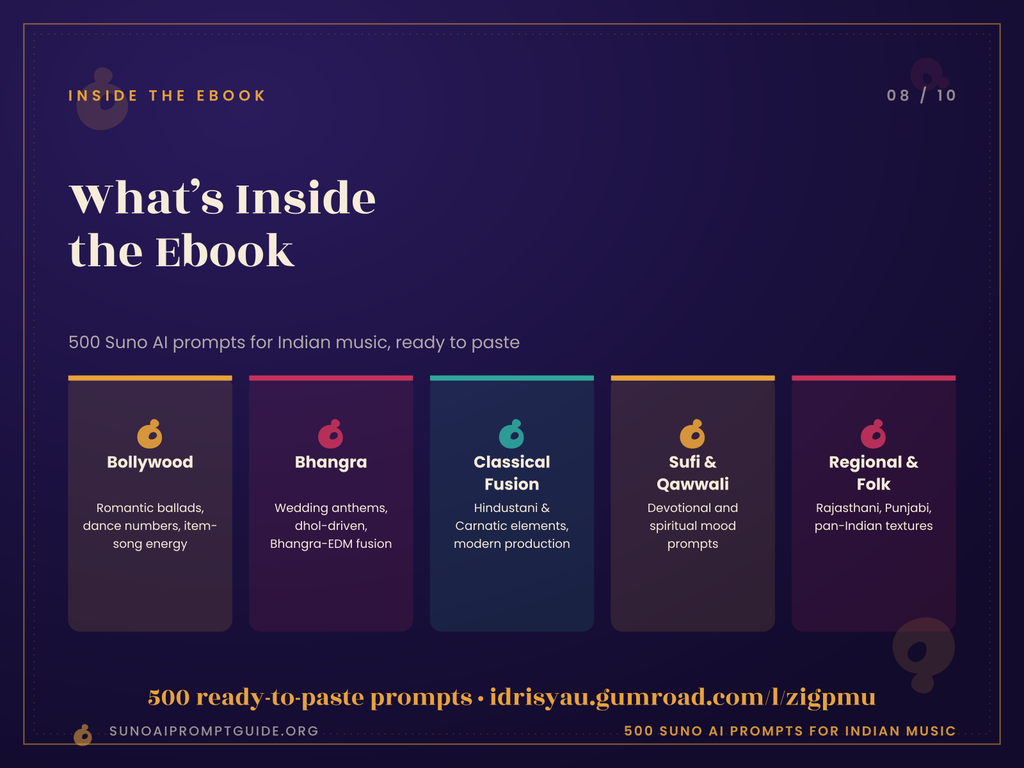
This isn’t a random scrape of generic tags. Every entry in the collection was built and tested specifically for Indian genres:
- Bollywood — romantic ballads, dance numbers, item-song energy, modern Bollywood-pop crossover
- Bhangra — wedding and party anthems, traditional dhol-driven tracks, Bhangra-EDM fusion
- Classical Fusion — Hindustani and Carnatic elements blended with modern production
- Sufi & Qawwali-inspired — devotional and spiritual mood prompts
- Regional & Folk — Rajasthani, Punjabi, and pan-Indian folk textures
- Ready-to-paste formatting, organized by mood, tempo, and use case
If you create content, run a YouTube channel, produce background music, or just want to stop wasting Suno credits on regenerations that miss the mark, this collection turns “random hindi song generator” guesswork into a repeatable system.
We built this as a companion to our broader catalog of prompts for Suno across genres — so if Indian music is just one piece of a bigger content calendar, you’re covered on every front, not just one. Every prompt in the collection is written in plain, copy-paste format: no jargon you need to decode, no trial-and-error required before you get a track worth keeping.
Download the 500 Suno AI Prompts for Indian Music ebook now →
A Quick Note on Using AI Music Responsibly
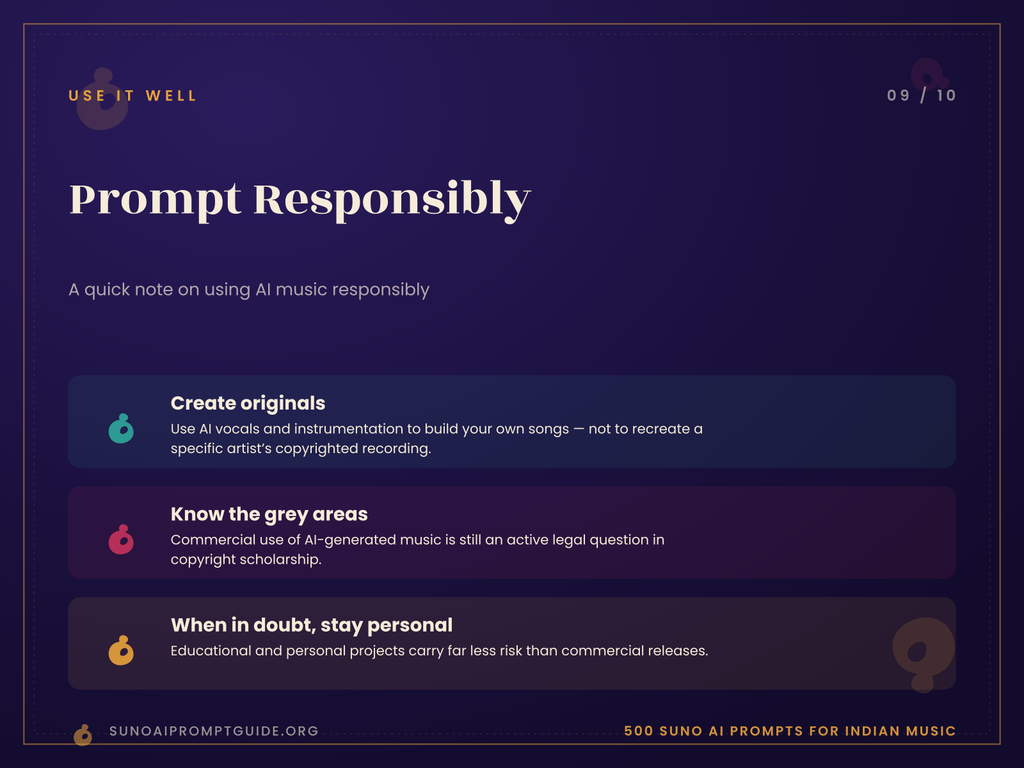
Because this space moves fast, it’s worth knowing the legal terrain is still being worked out. A 2025 analysis published in the Journal of World Intellectual Property examined how platforms like Suno raise unresolved questions about copyright, fair learning, and infringement — worth a skim if you’re planning to monetize AI-generated Indian music commercially rather than use it for personal or educational projects.
Frequently Asked Questions
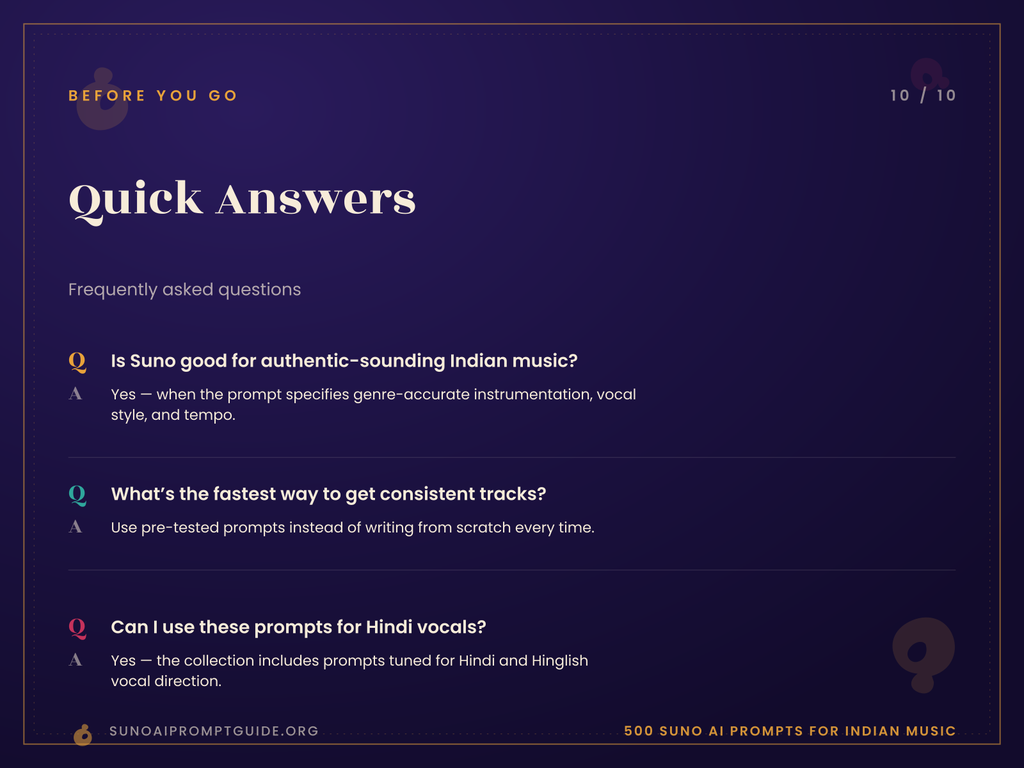
Is Suno good for generating authentic-sounding Indian music? Yes, when the prompt specifies genre-accurate instrumentation, vocal style, and tempo. Generic prompts produce generic results regardless of genre.
What’s the fastest way to get consistent Bollywood or Bhangra tracks? Use pre-tested prompts rather than writing from scratch each time. Our 500 Suno AI Prompts for Indian Music ebook gives you a ready-made library across every major Indian genre.
Can I use these prompts for Hindi vocals specifically? Yes — the collection includes prompts tuned for Hindi and Hinglish vocal direction, alongside our dedicated Hindi-language prompt guide for deeper lyric-focused work.
Ready to stop guessing and start generating Indian music that actually sounds like it belongs in the genre? Get instant access to all 500 prompts here.
Reference
- Civit M, Drai-Zerbib V, Lizcano D, Escalona MJ. SunoCaps: A novel dataset of text-prompt based AI-generated music with emotion annotations. Data Brief. 2024 Jul 18;55:110743. doi: 10.1016/j.dib.2024.110743. PMID: 39161878; PMCID: PMC11332804.
- T D, Praveen Kumar & Jain, Anil & Parin,. (2025). Enhancing Content Mastery through AI-Generated Songs: An Experimental Study Using Suno AI Platform.
- Choi, Wan Chong & Chang, Chi In & Choi, Hong Fai. (2025). Suno AI: Opportunities and Challenges of AI-Generated Music and Lyrics in Secondary Music Education. 10.36227/techrxiv.175756648.80424738/v1.
- Suno AI and musings of copyright: An enquiry into fair learning and infringement analysis of generative AI creation. Retrieved from here
- (1986). Indian Music as a Cultural System. Asian Music. 17. 98. 10.2307/833743. Retrieved from here
- Kunikullaya Ubrangala K, Kunnavil R, Sanjeeva Vernekar M, Goturu J, Vijayadas, Prakash VS, Murthy NS. Effect of Indian Music as an Auditory Stimulus on Physiological Measures of Stress, Anxiety, Cardiovascular and Autonomic Responses in Humans-A Randomized Controlled Trial. Eur J Investig Health Psychol Educ. 2022 Oct 19;12(10):1535-1558. doi: 10.3390/ejihpe12100108. PMID: 36286092; PMCID: PMC9601678.
- Rohit, Dr. (2014). THE GLOBLISATION OF INDIAN MUSIC: AN OVERVIEW. Retrieved from here