You can monetize Suno songs, but only if you set things up correctly from the start. The creators who earn from AI music have two things in common. They understand Suno’s commercial rights, and they generate tracks that sound good enough for someone to pay for or stream on repeat.
This guide covers both. You’ll learn what Suno allows, nine realistic ways to earn, the mistakes that get tracks removed, and how better prompting separates hobby songs from income-ready ones.
Want better tracks before you monetize? The 10,000 Suno AI Prompts ebook gives you a huge library of genre, mood and production prompts so you can stop guessing and start generating releasable music.
Can You Actually Make Money With Suno Songs?
Yes. Suno’s help center says songs made on a paid plan come with commercial use rights, which means you can distribute and sell them, and Suno doesn’t take a share of your earnings.
Two honest caveats before you get excited:
- Money is never guaranteed. Streaming pays fractions of a cent per play. Income comes from volume, quality, niche selection and good marketing, not from uploading a few random tracks.
- Competition is real. Millions of people use AI music tools. Generic songs disappear. Specific, well-produced songs aimed at a clear audience have a chance.
Treat Suno as a production tool, not a vending machine. Your income depends on what you do with the output.
Step 1: Understand Suno’s Commercial Rights (Do This First)
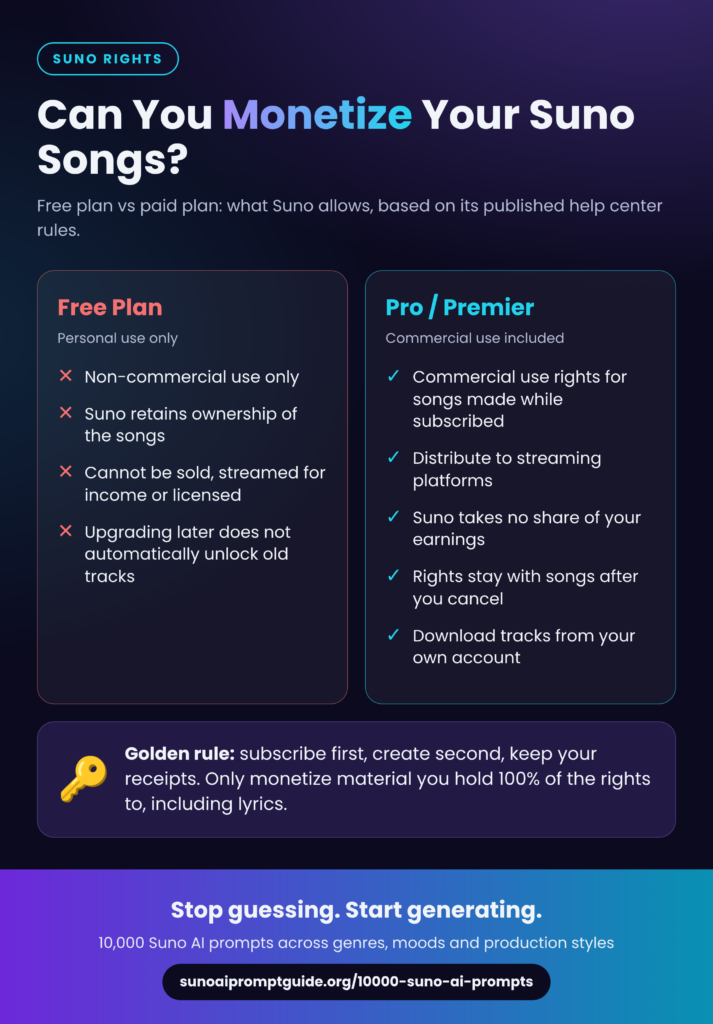
Skipping this step is the most expensive mistake you can make. Here’s what Suno’s published rules say:
- Free plan songs are non-commercial. Suno says it retains ownership of songs generated on the free plan, and you can’t monetize them.
- Paid plan songs come with commercial rights. If you were subscribed to Pro or Premier when a song was created, you hold commercial use rights, and Suno states you keep those rights even if you later cancel.
- Subscribing later doesn’t fix old songs. Upgrading does not automatically give you rights to tracks you made on the free plan. Suno says it may offer retroactive rights in certain cases, but that isn’t guaranteed.
- Your own lyrics are different. If you wrote the lyrics yourself, you can use them. But if you use someone else’s lyrics, you can’t monetize the song.
- Downloads are changing. Following Suno’s licensing partnership with Warner Music Group, downloads require a paid account and are capped each month by tier. Check the current limits on Suno’s pricing page, because these numbers have been changing. Some third-party reports say the commercial license applies only to songs downloaded through Suno itself, so download every track you plan to release directly from your account.
Practical rule: subscribe first, create second, and keep a record (screenshots, download dates, your plan receipts) for every track you release. Terms change, so re-read Suno’s rights pages before you publish anything big. This article is general information, not legal advice.
One more point about copyright. Suno notes that AI-generated material may not be eligible for copyright protection in every country. That doesn’t stop you from earning, but it does affect how much exclusivity you can claim. Adding your own lyrics, arrangement, vocal recording or editing strengthens your position.
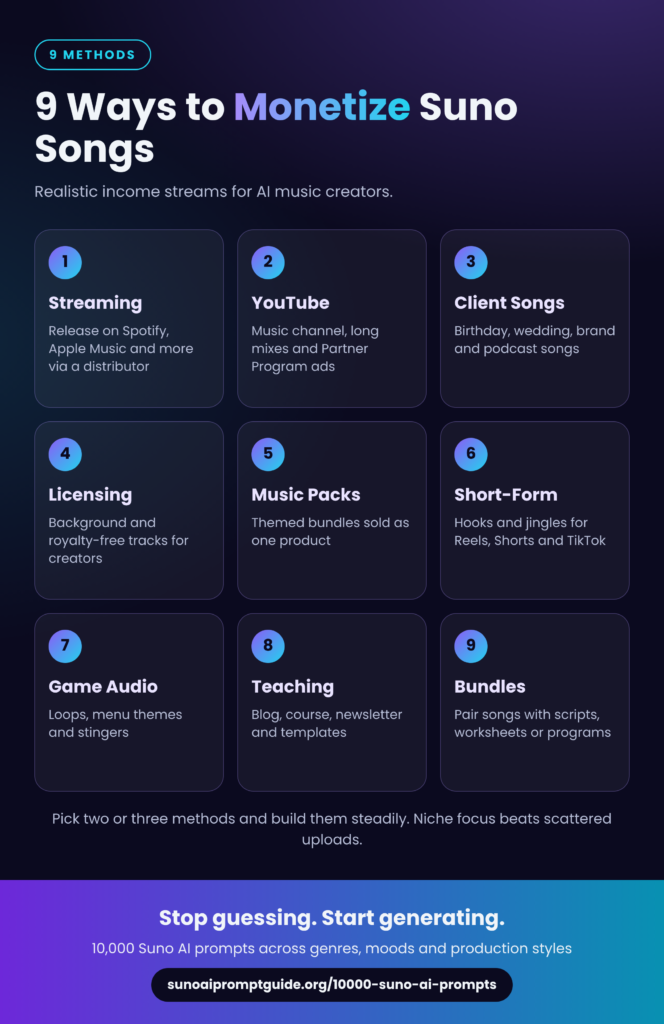
Method 1: Release Songs on Spotify, Apple Music and Other Streaming Platforms
This is the most popular route. You upload tracks through a music distributor, and the distributor delivers them to Spotify, Apple Music, Amazon Music, YouTube Music and more.
How to do it well:
- Check your chosen distributor’s current AI-music policy before you pay. Policies differ and have shifted over the past year.
- Release under an artist name with a consistent sound. A random mix of genres confuses listeners and playlist algorithms.
- Write original lyrics when you can. It improves quality and ownership clarity.
- Create proper cover art and metadata. Sloppy releases look like spam.
- Disclose AI use where the platform asks for it.
Reality check: Streaming income builds slowly. Treat each song as one small asset in a growing catalog. Focused catalogs, such as lo-fi study beats, sleep music, gospel, Afrobeats, amapiano or workout tracks, tend to perform better than scattered ones.
If you aren’t sure how to get a consistent genre sound across 20 or 30 tracks, that’s exactly where a structured prompt library helps. The 10,000 Suno AI Prompts pack is organized so you can stay inside one style and still keep songs varied.
Method 2: Build a YouTube Music Channel
YouTube is the best place for AI music creators because it rewards watch time, and music is ideal for long viewing sessions.
Channel ideas that work:
- Study and focus mixes
- Sleep and relaxation music
- Workout and running playlists
- Genre-specific compilations (jazz café, synthwave, gospel worship, Afro house)
- Background music for gaming or work
- Lyric videos for original songs
How you earn: ad revenue once you qualify for the YouTube Partner Program, plus affiliate links in descriptions, plus selling your own products to the audience you build.
Long mixes of 1–3 hours often perform well because viewers leave them running. Make sure you read YouTube’s current policy on AI-generated and “inauthentic” content, and add original value through visuals, curation and clear channel branding. Mass-produced, near-identical uploads risk demonetization.
Method 3: Create Custom Songs for Clients
Many people and businesses want a song but can’t afford a studio. You can sell Suno-assisted music as a service.
Popular offers:
- Birthday, anniversary and wedding songs
- Jingles for local businesses
- Podcast intros and outros
- Songs for YouTube creators
- Church, school and event theme songs
- Brand and product anthems
How to price it: Start with a small package and a clear turnaround, then raise rates as your samples improve. Personalized songs are worth more than generic ones because the buyer is paying for the story, names and details, not just audio.
Important: Generate client songs while subscribed to a paid plan, download them from your account, and be upfront that AI tools are part of your process. Honest positioning builds trust, and some clients actively like the speed.
Method 4: License Your Tracks as Background or Royalty-Free Music
Video creators, podcasters, app developers and small agencies constantly need affordable background music. You can sell licenses on your own website or through platforms that accept AI-assisted music.
What sells best:
- Short, clean instrumentals with clear moods (upbeat, calm, dramatic, inspiring)
- Loopable tracks
- Multiple lengths of the same song (15, 30, 60 seconds and full)
- Tracks grouped into themed packs
Write a plain-language license that states what buyers can and can’t do, and have a lawyer review it before you start selling at scale. Keep your Suno plan receipts and download records so you can show where each track came from.
Method 5: Sell Music Packs and Bundles
Bundles turn many small tracks into one higher-priced product. Think “50 Lo-Fi Study Beats,” “Corporate Background Music Pack” or “Faith-Based Worship Instrumentals.”
Sell them on your own site, through a digital storefront, or on marketplaces that allow AI-assisted work. Bundles work because buyers get value and variety for one purchase, and you only have to promote one product.
To produce a coherent pack, you need repeatable prompts that hold a consistent sound. This is where a prompt library saves hours. Instead of experimenting for each track, you start from tested style, mood and instrument combinations and refine from there.
Method 6: Create Songs for Social Media and Short-Form Video
Short clips on TikTok, Instagram Reels and YouTube Shorts need catchy hooks. You can:
- Release original songs and drive traffic to full versions
- Make music-led content (song stories, “AI wrote this” reveals, genre mashups)
- Offer custom jingles to creators and brands
- Build an audience first, then monetize through streaming, sponsorships and products
Hooks matter most. A strong first ten seconds decides whether people stay. Learn to describe vocal style, tempo, energy and structure clearly in your prompts, and your hit rate climbs.
Method 7: Sell Audio for Games, Apps and Videos
Indie game developers, mobile app makers and explainer-video studios often need loops, menu themes, ambient beds and stingers. Create themed sets (fantasy tavern, sci-fi exploration, calm puzzle, upbeat arcade), export clean versions and sell them as asset packs or custom work.
Specificity wins here. A developer searching for “calm puzzle game music loop” will pay for exactly that, not a general-purpose song.
Method 8: Teach What You’ve Learned
Once you get decent results, there’s a market for people who want to learn. You can monetize through:
- A blog or YouTube channel about AI music creation
- A short course or workshop
- A newsletter with tips and prompt breakdowns
- Templates, checklists and prompt packs
Many creators earn more from teaching Suno than from the songs themselves, because the audience is large and growing. If you’d rather not build prompt resources from scratch, you can start with a ready-made library and focus on creating and publishing.
Method 9: Combine Songs With Other Products
Music can add value to something else you sell. Examples include meditation audio with guided scripts, kids’ learning songs with printable worksheets, fitness programs with custom workout tracks, and church or community resources with original worship music.
Pairing songs with another asset makes your offer harder to copy and easier to price.
Quality starts with the prompt. Every method above depends on tracks that sound polished. The 10,000 Suno AI Prompts ebook is built to help you create stronger songs faster across genres, moods and production styles.
Why Prompt Quality Decides Your Income
Two creators can use the same Suno plan and get wildly different results. The difference is almost always the prompt.
A weak prompt looks like this: “Make a sad song.” You get a generic, forgettable result and burn credits getting there.
A strong prompt gives Suno direction on genre and sub-genre, mood, tempo, instruments, vocal character, production style and song structure. The more precisely you describe what you want, the fewer rerolls you need. Since credits and downloads are limited on every paid tier, efficient prompting directly protects your profit. Every wasted generation costs you money.
Good prompts also give you consistency. If you’re building a catalog, a channel or a music pack, you need your tracks to feel like they belong together. That’s hard to do with guesswork and easy to do with a proven library.
That’s the idea behind the 10,000 Suno AI Prompts ebook. Rather than starting from a blank box every time, you pick from a huge range of genre, mood and production directions, adapt them to your project, and get to usable tracks sooner. If you’re serious about turning Suno into income, better inputs are the cheapest upgrade you can make.
Common Mistakes That Kill Suno Income
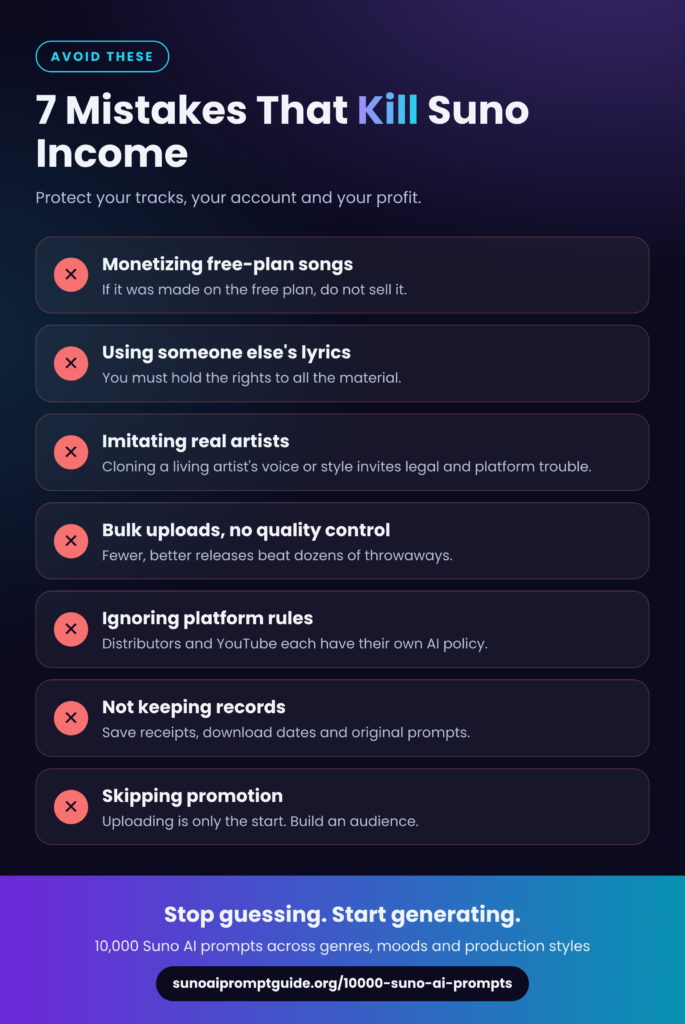
1. Monetizing free-plan songs. If you made it on the free plan, don’t sell it or release it commercially.
2. Using someone else’s lyrics. You must hold the rights to all the material. Copied or borrowed lyrics can get tracks removed and accounts flagged.
3. Imitating real artists. Suno blocks direct prompts that target a known artist’s likeness or a specific song, and trying to clone a living artist’s voice or style too closely can create legal and platform problems.
4. Uploading in bulk with no quality control. Distributors and streaming platforms are tightening policies on low-effort AI uploads. Fewer, better releases beat dozens of throwaways.
5. Ignoring platform rules. Each distributor, marketplace and YouTube has its own AI policy. Read them before you upload, and re-read them periodically.
6. Not keeping records. Save plan receipts, download dates and original prompts. If a platform questions your release, documentation protects you.
7. Skipping promotion. Uploading is the start. Without playlists pitching, social content, an email list or a YouTube audience, even good songs sit unheard.
A Simple 30-Day Plan to Start Earning
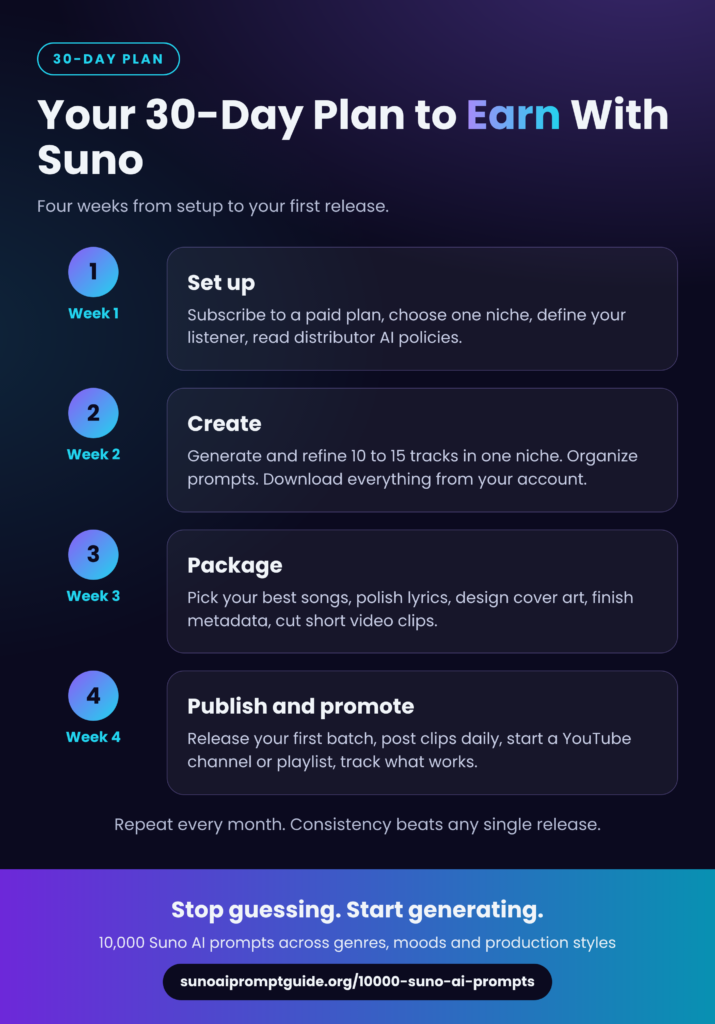
Week 1: Set up. Subscribe to a paid plan, choose one niche, and write down your target listener. Research two or three distributors and read their AI policies.
Week 2: Create. Generate and refine 10–15 tracks in your chosen niche. Keep your prompts organized so you can reuse what works. Download everything from your account.
Week 3: Package. Pick your best songs, write or refine lyrics, design cover art, finish metadata, and prepare short video clips for social media.
Week 4: Publish and promote. Release your first batch, post clips daily, and start a YouTube channel or playlist. Track what gets traction and double down on it.
Repeat the cycle every month. Income from AI music compounds slowly, so consistency matters more than any single release.
Frequently Asked Questions
Can I monetize Suno songs on the free plan?
No. Songs made on Suno’s free plan are limited to non-commercial use, and Suno retains ownership of them. You need an active Pro or Premier subscription at the time a song is created to receive commercial rights.
Do I keep commercial rights if I cancel my Suno subscription?
According to Suno’s help center, if you were subscribed to Pro or Premier when a song was created, you retain commercial use rights for that song after your subscription ends. Always re-check Suno’s current terms, since policies can change.
Can I put Suno songs on Spotify?
Yes, songs created under a paid plan can be distributed to streaming platforms through a music distributor. Check your distributor’s AI-music policy first, because rules vary and change.
How much money can I make with Suno?
There’s no fixed figure. Earnings depend on your niche, track quality, release volume, marketing and the monetization methods you combine. Beginners should expect slow growth and treat income as something that builds over months.
Is AI-generated music copyrighted?
It depends on your country and how much human creativity you add. Suno notes that AI-generated material may not be eligible for copyright protection in every case. Writing your own lyrics, arranging and editing the output can strengthen your claim.
Can I use Suno songs on YouTube and earn from them?
You can upload them to YouTube if you hold commercial rights, and you may earn through the YouTube Partner Program once eligible. Follow YouTube’s policies on AI content and avoid repetitive, low-value uploads.
What’s the best way to get better Suno results?
Write detailed, structured prompts that specify genre, mood, tempo, instruments, vocal style and structure. A ready-made library such as the 10,000 Suno AI Prompts ebook can speed up the process and keep your catalog consistent.
Final Thoughts: Turn Suno Into a Real Income Stream
Learning how to monetize Suno songs comes down to a few principles. Start on a paid plan so your rights are clear. Pick a niche and stay focused. Use original lyrics and honest disclosure. Choose two or three monetization methods and build them steadily instead of chasing everything at once.
The creators who win aren’t the ones who generate the most songs. They’re the ones who generate the right songs, with clear direction and a plan for getting them heard or sold.
Prompts are where that starts. If you want a faster, more reliable way to create release-ready tracks across genres and moods, grab the 10,000 Suno AI Prompts ebook and start building your catalog with confidence.