A few years ago, producing a Bollywood-style song meant a studio, a singer, a tabla player and a serious budget. Today, you can type a sentence, press a button and hear a full song with vocals, dhol, sitar and strings in under a minute. If you have been wondering how to create Indian music using AI online or how to create Indian music using an AI app, this guide walks you through the whole process, from choosing a tool to writing prompts that actually sound Indian rather than generic.
By the end, you will know the exact prompt structure that works, the mistakes that make AI songs sound flat, and where to find ready-made prompts so you never start from a blank page.
Can AI Really Make Authentic Indian Music?
Yes, with one condition: the AI only sounds as good as the instructions you give it. Modern AI music generators have learned from huge amounts of audio, so they already understand the difference between a Punjabi bhangra beat, a Bollywood love ballad, a Carnatic-inspired fusion piece and a lo-fi Hindi chill track. What they cannot do is read your mind.
If you type “make an Indian song,” you will get something vague. If you type a prompt that names the genre, instruments, tempo, mood, language and vocal style, you get something you can actually use. The skill of Indian AI music is not coding or production. It is prompting.
Even the film industry has noticed. Composer A.R. Rahman used AI to recreate the voices of two late singers for a song in the 2024 Tamil film Lal Salaam, with permission from their families. That is a very different use from random voice cloning, but it shows AI is already part of Indian music conversations.
What You Need Before You Start
You need very little:
- An AI music generator. Suno is the most popular choice for full songs with vocals. Udio and a few others are alternatives.
- A browser or phone. Most tools run online, and Suno also offers a mobile app, which is why many beginners search for how to create Indian music using an AI app.
- A basic idea. A mood, a theme or a story is enough.
- A prompt. This is the part that decides everything.
A free account is fine for experimenting. If you plan to publish or sell your music, read the commercial-use terms of the plan you are on, because free and paid tiers usually differ.
How to Create Indian Music Using AI Online: 6 Steps
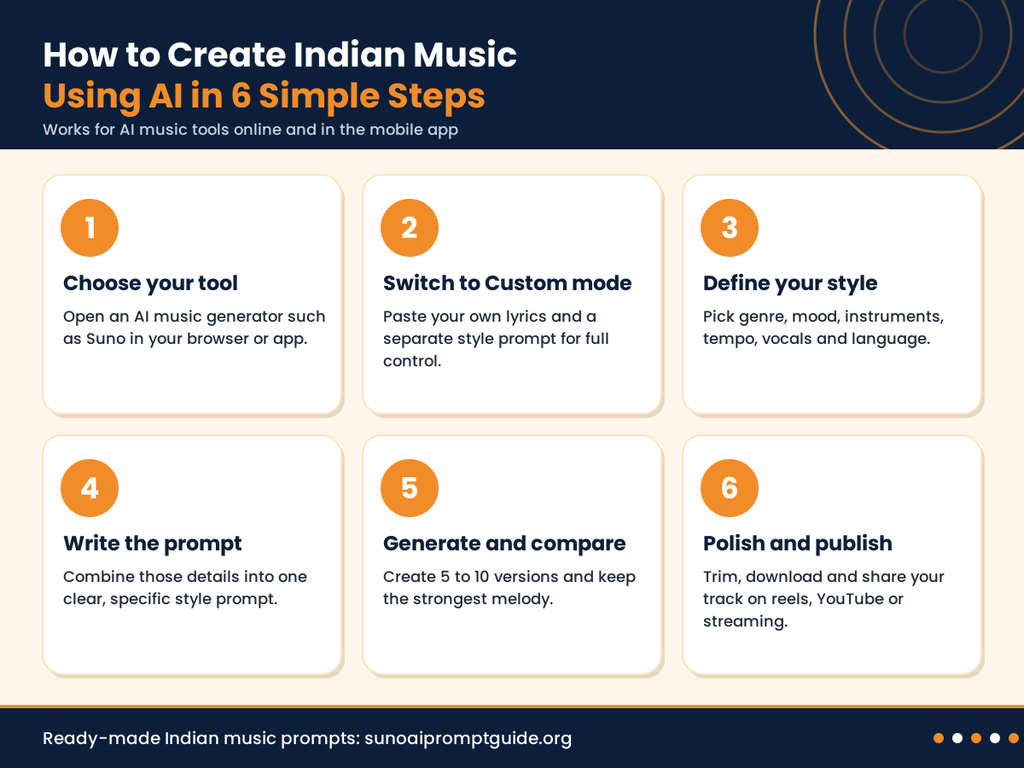
Step 1: Choose Your Tool and Format
Open your AI music generator in a browser or install its app. The online version is better for longer sessions because typing detailed prompts and lyrics is easier on a keyboard. The app is great for capturing ideas on the go. Both use the same core process.
Choose between two modes:
- Simple mode: you describe the song in one sentence and the AI writes lyrics too.
- Custom mode: you paste your own lyrics and a separate style prompt. This is the mode to use for Indian music, because it gives you control over language, structure and sound.
Step 2: Decide the Style Before You Type
Write down five things:
- Genre: Bollywood pop, Punjabi folk, ghazal, qawwali, Indian classical fusion, Tamil film style, Bengali Baul, devotional bhajan.
- Mood: romantic, nostalgic, energetic, spiritual, melancholic.
- Instruments: tabla, dholak, sitar, bansuri, harmonium, sarangi, veena, santoor.
- Tempo: slow ballad, mid-tempo groove, fast dance track.
- Vocals: male, female, duet, soft, powerful, folk-style.
This five-point list is the foundation of every good prompt.
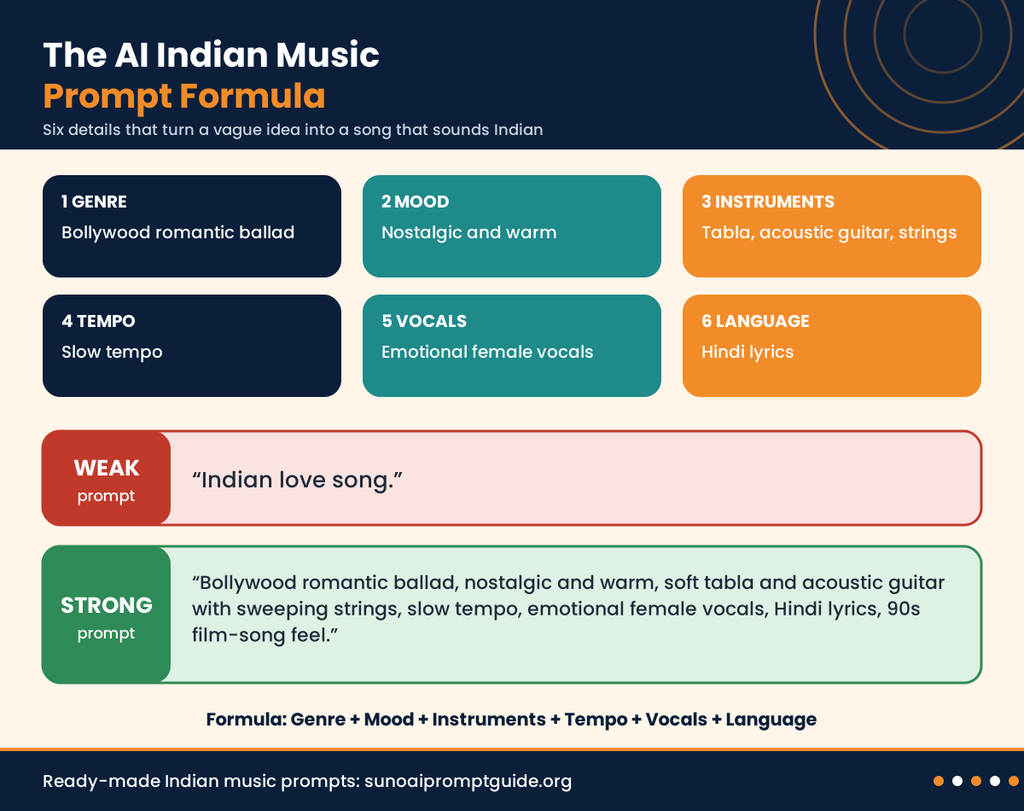
Step 3: Use a Simple Prompt Formula
The formula that works most reliably is:
[Genre] + [Mood] + [Instruments] + [Tempo] + [Vocal style] + [Language]
Here is a weak prompt and a strong one.
Weak: “Indian love song.”
Strong: “Bollywood romantic ballad, nostalgic and warm, soft tabla and acoustic guitar with sweeping strings, slow tempo, emotional female vocals, Hindi lyrics, 90s film-song feel.”
The strong version tells the AI exactly what to build. Try swapping one element at a time, such as changing the instruments or the era, and you will quickly learn what each word does.
Step 4: Write or Generate Your Lyrics
For Hindi songs, write your lyrics in clear, simple Hindi or in Roman script (Hinglish) depending on what the tool pronounces better. Test both. Keep lines short, repeat your chorus, and mark sections with tags like [Verse], [Chorus] and [Bridge].
If you are not confident writing lyrics, you can ask a chatbot to draft them. Tell it the theme, language, number of verses and the emotion, then edit the result by hand so it sounds like you.
Step 5: Generate, Listen and Iterate
Never settle on the first result. Generate several versions, listen for the one with the best melody, and then adjust. Common fixes:
- Vocals too Western? Add “Indian classical-influenced vocals” or “folk singing style.”
- Beat too generic? Name the percussion, such as “dhol-driven bhangra rhythm.”
- Song too busy? Remove instruments from the prompt.
- Pronunciation off? Re-spell tricky words phonetically.
The creators who get the best results often generate ten or more versions of one idea.
Step 6: Polish and Export
Once you have a version you love, download it, trim the intro or outro if needed, and add it to your video, reel or release plan. If you want to go further, you can import the track into a free editor to adjust volume or add effects.
Prompt Examples You Can Try Today
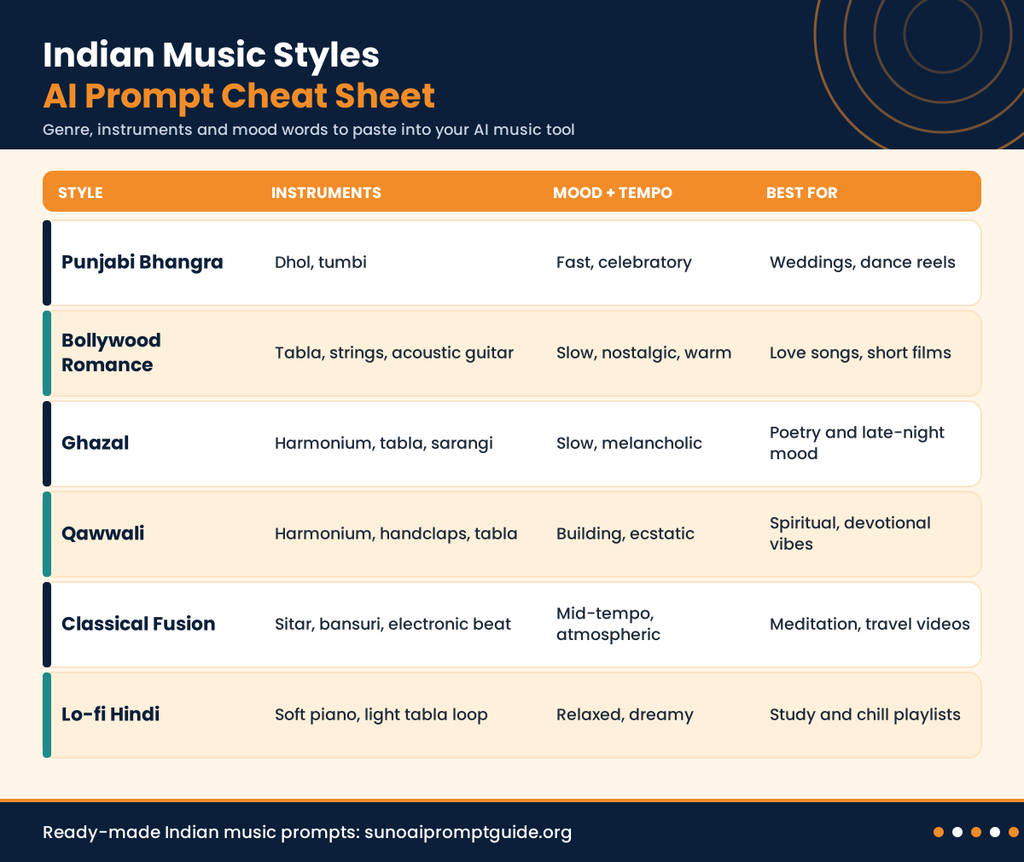
Copy these into the style box of your AI music tool and adjust them to your idea.
Punjabi bhangra: “High-energy Punjabi bhangra, dhol and tumbi, fast tempo, powerful male vocals, celebratory wedding mood, Punjabi lyrics.”
Lo-fi Hindi: “Lo-fi Hindi chill beat, soft piano, light tabla loop, relaxed tempo, dreamy female vocals, late-night mood.”
Ghazal: “Classic ghazal, harmonium, tabla and sarangi, slow tempo, deep emotional male vocals, Urdu poetry feel, intimate and melancholic.”
Qawwali: “Traditional qawwali, harmonium, handclaps and tabla, building intensity, call-and-response group vocals, spiritual and ecstatic.”
Classical fusion: “Indian classical fusion, sitar and bansuri over a modern electronic beat, mid-tempo, atmospheric, instrumental.”
These work well, but they are only a starting point. Every genre has dozens of sub-styles, regional sounds and era-specific flavours, and finding the exact wording that triggers them takes a lot of trial and error. That is where a prompt library saves hours.
Skip the Trial and Error: Ready-Made Indian Music Prompts
Most beginners waste their free credits testing weak prompts. If you would rather start with prompts that are already structured for Indian styles, these three guides are built for exactly that:
- Suno AI Prompts for Indian Music in Hindi is the right pick if you want Hindi songs, from Bollywood romance to devotional and film-style tracks, with prompts and lyric structures designed around the language.
- Suno AI Prompts for Indian Music covers the wider Indian sound: regional folk, classical fusion, wedding music, ghazal, qawwali and more, so you can move beyond one genre.
- 10,000 Suno AI Prompts is the full vault for creators who want every genre, mood and language in one place, including Indian styles, and never want to run out of ideas.
If you are serious about publishing consistently, whether on YouTube, Instagram Reels or streaming platforms, having a tested prompt bank is the difference between making one song a week and ten.
7 Mistakes That Make AI Indian Music Sound Fake
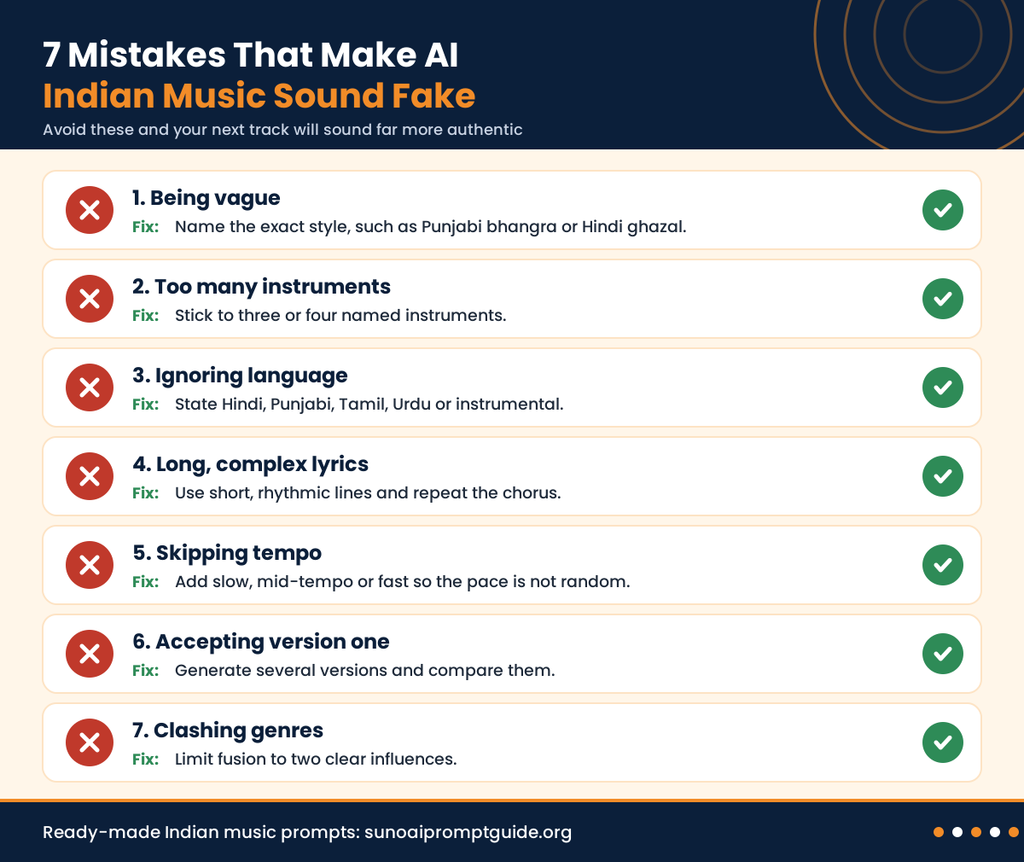
- Being vague. “Indian music” covers thousands of styles. Be specific.
- Stacking too many instruments. Three or four named instruments beat a crowded list.
- Ignoring language. Always state Hindi, Punjabi, Tamil, Urdu or instrumental.
- Long, complicated lyrics. Short, rhythmic lines are sung more naturally.
- Skipping tempo. Without a tempo cue, the pace is random.
- Accepting the first output. Generate multiple versions.
- Mixing clashing genres. Fusion is fun, but keep it to two clear influences.
Which Ebook Should You Choose?
If you are unsure where to begin, here is a quick way to decide.
You mostly want Hindi songs: start with the Hindi Indian music prompt guide.
You want variety across Indian styles and regions: pick the Indian music prompt guide.
You make music in many genres, or you want to build a content channel or catalogue: the 10,000 prompt vault gives you the widest range for the best long-term value.
Any of them lets you open your AI tool, paste a proven prompt and start generating immediately instead of guessing.
Frequently Asked Questions About Creating Music With AI
Can I create my own music with AI?
Yes. Tools like Suno let you describe a song in text, add your own lyrics, and receive a complete track with vocals and instruments. You do not need to read music or play an instrument. Your creative input is the prompt, the lyrics and the choices you make while selecting and refining versions.
Can ChatGPT create music?
ChatGPT and similar chatbots are excellent for writing lyrics, song structures, chord ideas and style prompts, but they are not full music generators in the way Suno or Udio are. The most common workflow is to draft lyrics and a prompt with a chatbot, then paste them into a dedicated AI music tool to produce the audio.
Which AI is best for making music?
It depends on your goal. Suno is widely used for complete songs with vocals and is popular with Indian music creators because it responds well to detailed style prompts. Udio is another strong option, and some tools focus on instrumentals or background music. Try the free tiers of two or three, then stay with the one that matches your sound.
Can you legally use AI to write a song?
Generally yes, but the details matter. Rules differ by country and by tool. In the United States, the Copyright Office has said that works need meaningful human authorship, so purely AI-generated output may not receive copyright protection, while your own lyrics and creative arrangement can. Each platform also sets its own terms, and free plans often restrict commercial use. Avoid copying real artists’ voices or copyrighted lyrics, and check the terms of your plan before you publish. This is general information, not legal advice, so consult a lawyer for anything high stakes.
Can you tell if a song was written by AI?
Sometimes. Clues include slightly unnatural breathing, blurry consonants, oddly perfect repetition and vocals that sound too smooth. But the technology improves quickly, and many listeners cannot tell. Some streaming services and detection companies are building tools to flag AI-generated tracks, and a growing number of platforms ask creators to disclose AI use.
Where can I sell my AI music?
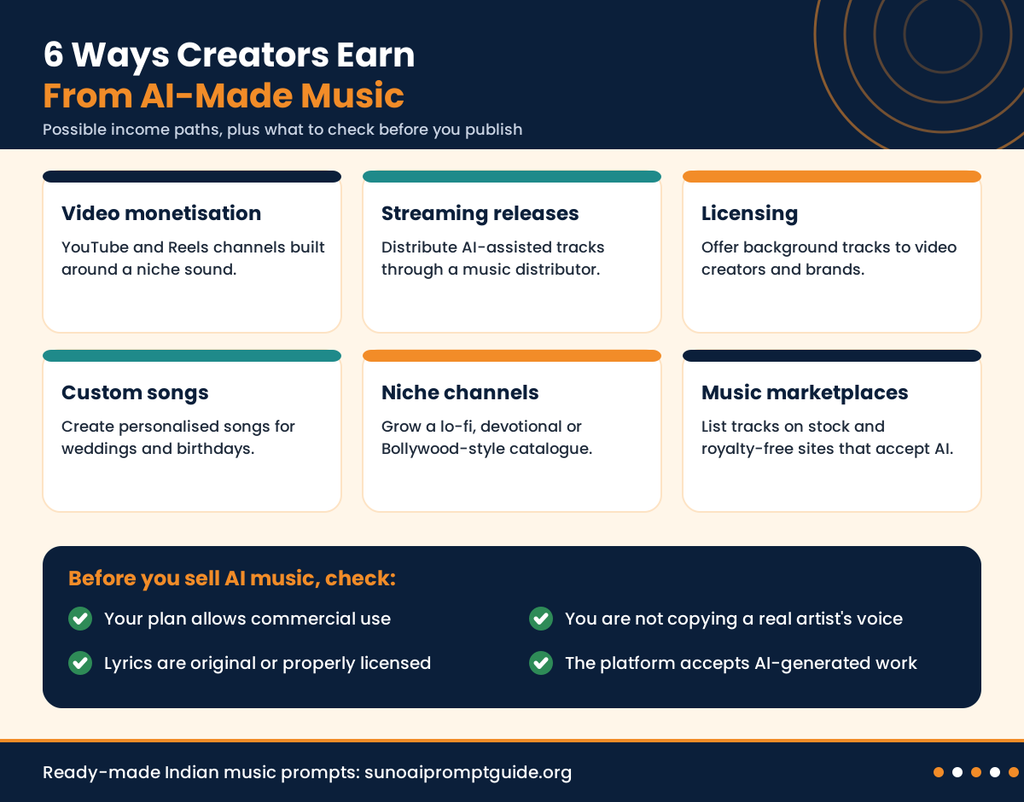
Options include music distributors that deliver to streaming platforms, stock and royalty-free music marketplaces, YouTube and short-video platforms for monetised content, and licensing to creators who need background tracks. Always confirm that your AI tool’s plan allows commercial use and that the marketplace accepts AI-generated work.
What famous songs are written by AI?
A few have become well known. “Daddy’s Car” (2016) was created with Sony’s Flow Machines in the style of The Beatles. “Heart on My Sleeve” (2023) went viral by imitating the voices of Drake and The Weeknd, and was removed from major platforms. In India, A.R. Rahman’s use of AI to recreate late singers’ voices for Lal Salaam drew wide attention.
Can you make money with AI songs?
Yes, though it takes consistency rather than luck. Creators earn through streaming royalties, YouTube and Reels monetisation, licensing music to video makers, selling custom songs for weddings and birthdays, and building channels around a niche such as Hindi lo-fi or devotional music. A large prompt library helps you publish more often and test more styles.
What is the most successful AI-generated song?
There is no single official answer, and rankings change fast. Viral cases like “Heart on My Sleeve” drew millions of listens, while in 2025 AI-created acts such as Xania Monet and Breaking Rust reached Billboard sales and airplay charts. Check recent chart news for the latest record holder.
Does Spotify ban AI music?
No, Spotify does not ban AI music outright. It has said it targets spam, deceptive uploads and unauthorised voice impersonation, and it has removed large numbers of low-quality or misleading tracks. Original AI-assisted music that follows the rules can be listed, but policies keep evolving, so review the current guidelines.
Can I sell AI-generated music on Spotify?
You can distribute AI-assisted music to Spotify through a distributor, provided you have the commercial rights from your AI tool, you are not imitating real artists, and the distributor accepts it. Some distributors require you to disclose AI involvement. Read both the distributor’s and your AI platform’s terms first.
Who is a famous AI-generated singer?
Xania Monet is among the best-known AI-generated artists, a virtual singer built around AI-generated vocals and human-written lyrics that attracted a major record deal in 2025. Others, such as Breaking Rust and The Velvet Sundown, also drew headlines. Virtual idols like Hatsune Miku are older, synthesised voices rather than modern generative AI.
Final Thoughts: Start Creating Indian Music With AI Today
Learning how to create Indian music using AI online or through an app comes down to a repeatable routine: pick your tool, define genre, mood, instruments, tempo, vocals and language, write short singable lyrics, then generate and refine several versions. The creators who stand out are the ones who keep experimenting and keep publishing.
To speed that up, grab the prompt guide that fits your goal: the Hindi Indian music prompts, the Indian music prompts for all regional styles, or the full 10,000 Suno AI prompts vault. Open your AI music tool, paste a prompt, and hear your first Indian track in minutes.