Type “EDM” into Suno and you’ll get a track. It just probably won’t be the track you had in mind.
That’s the most common frustration with dance music in Suno. The prompt is too broad, so the result is a safe average of everything the word suggests. Writing better prompts takes practice, and most people spend a lot of generations getting there.
Short on time? I put together an EDM Prompts for Suno ebook with ready-to-use starting points for different EDM styles, so you don’t have to build every prompt from scratch. The rest of this article explains why that matters.
Why “EDM” Alone Gives You Generic Results
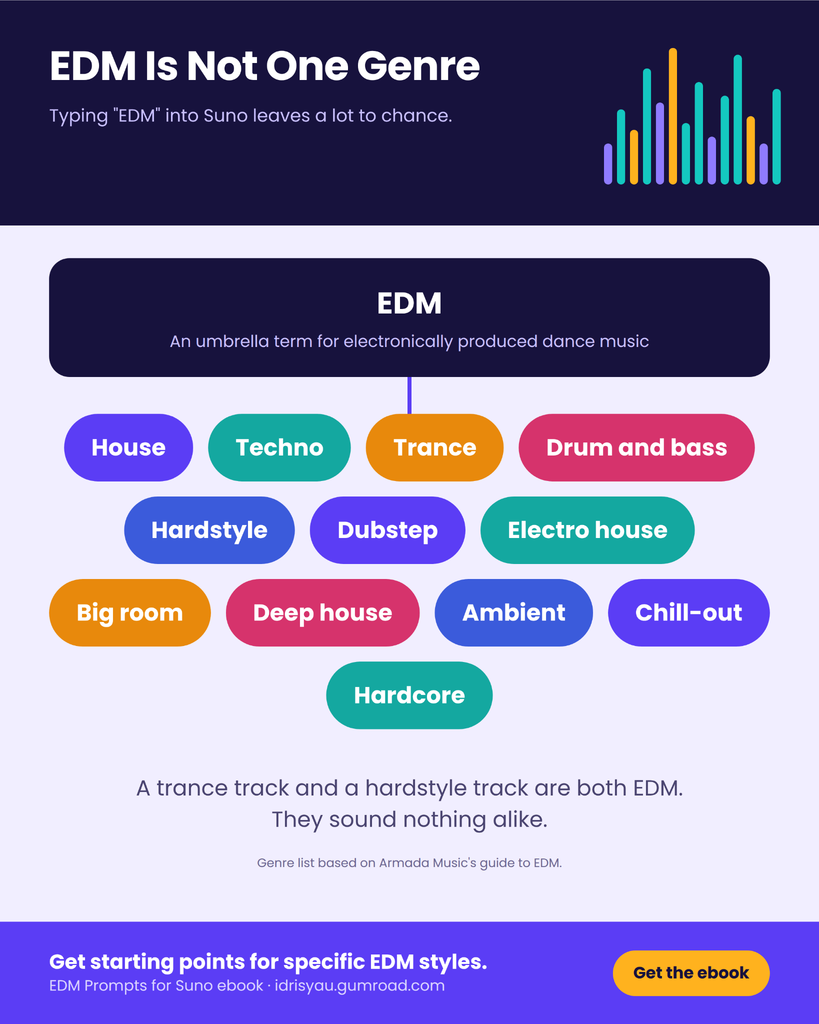
EDM isn’t one genre. Armada Music describes it as an umbrella term for all electronically produced dance music, including house, techno, trance, drum and bass, hardstyle and more. Wikipedia’s overview makes the same point: the term covers many genres and subgenres that all predate the name.
So when a prompt says only “EDM,” Suno has to guess which of those worlds you mean. A trance track and a hardstyle track are both EDM, and they sound nothing alike.
What a Strong EDM Prompt Needs to Cover
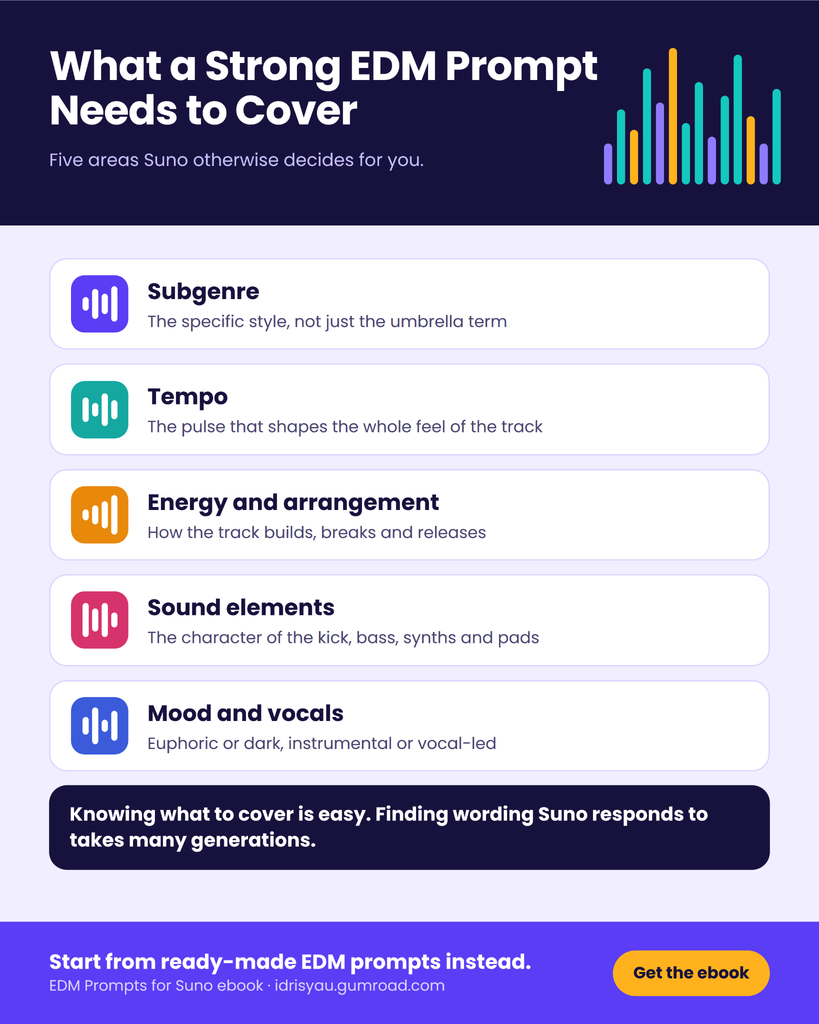
Better prompts tend to be specific about a handful of things. You won’t always need all of them, but each one you skip is something Suno decides for you.
- The subgenre. Naming the actual style matters more than any adjective.
- The tempo. Dance music is built around it, and it shapes the whole feel of a track.
- The energy and arrangement. Whether the track builds slowly, breaks down, or hits hard early.
- The sound elements. The character of the kick, bass, synths and pads.
- The mood and vocals. Euphoric or dark, instrumental or vocal-led.
Knowing what to cover is the easy part. Phrasing each one in a way Suno responds to is where most of the trial and error happens.
Structure Matters as Much as Sound
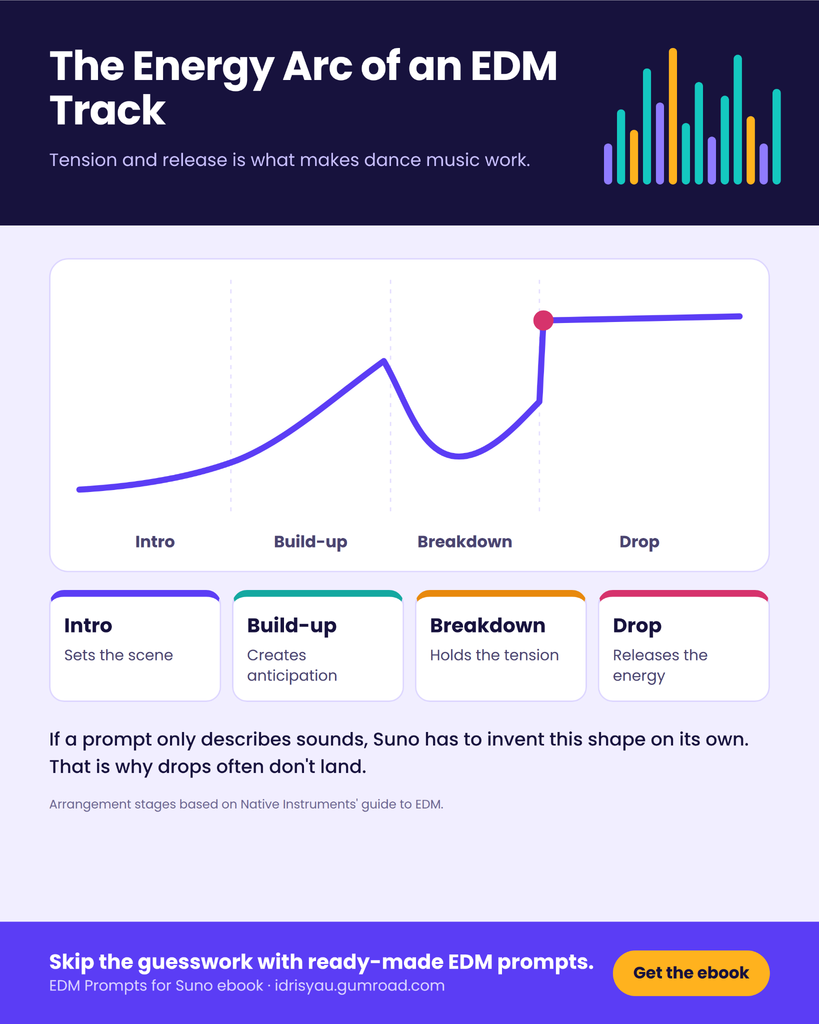
EDM lives on tension and release. Native Instruments describes a typical arrangement as an intro that sets the scene, build-ups and breakdowns that create anticipation, and a drop that releases the energy.
If your prompt only describes sounds, Suno has to invent that shape on its own, and drops that don’t land are a common result. How you describe the arc, and how strongly, changes the outcome from one generation to the next. Expect to regenerate several times either way.
Mixing EDM With Other Styles
Dance music has always borrowed from other genres. Wikipedia notes that Afro-EDM blends African rhythms with electronic production, and gqom from South Africa and Afrobeats from Nigeria are two well-known examples.
If you want to experiment with blends, these guides show how other styles are handled in Suno:
- Suno AI K-pop prompt guide for polished, hook-heavy dance-pop
- Latin prompt guide for Latin rhythm and vocal phrasing
- Brazilian phonk prompt guide for bass-heavy, club-ready sounds
A useful rule when blending: decide which style leads and which supports. If both compete, the track often sounds confused.
Want More EDM Prompts for Suno?
Here’s the honest problem with learning this by trial and error: it’s slow. You write a prompt, generate, listen, tweak one detail, and generate again. Do that across several styles and the setup takes longer than the music.
The EDM Prompts for Suno ebook is meant to shorten that step. It gives you ready-made prompt starting points for different EDM styles, so you begin from something structured instead of a blank box.
It’s a good fit if you:
- Are new to Suno and unsure how to phrase a genre or subgenre
- Keep rewriting similar EDM prompts from scratch
- Want to try several EDM styles without building each prompt yourself
It’s not a substitute for listening and adjusting. You’ll still tune each prompt to your own idea, but you’ll be adjusting instead of starting cold.
Get the EDM Prompts for Suno ebook here
Tips for Getting Better Results
A few habits help whatever prompts you use:
- Change one thing at a time. If you rewrite everything, you can’t tell what improved the track.
- Keep notes. Save the prompts that worked so you can reuse and refine them.
- Be selective. A few clear choices usually beat a long pile of adjectives.
- Regenerate. Results vary, so one attempt rarely tells you the full story.
Frequently Asked Questions
What is the best prompt for EDM in Suno?
There isn’t one best prompt. It depends on the subgenre you want. Prompts that name a specific style and describe the track’s energy tend to work better than a bare “EDM.” If you’d like a ready-made starting point, the EDM Prompts for Suno ebook covers different EDM styles.
Should I put a BPM in my Suno prompt?
It often helps, since tempo defines much of a dance track’s feel. Suno won’t always land on the exact number, so treat it as guidance.
Can Suno make instrumental EDM?
Yes. You can ask for an instrumental and describe the arrangement using terms like build-up, breakdown and drop.
Why doesn’t my drop sound right?
Drops depend on what comes before them, so the build-up and the bass and kick character all matter. Results vary between generations, so plan on a few attempts.
Which EDM genres are easiest to prompt?
Styles with clear, well-known traits, like house and trance, are usually easier to steer. Blended or niche styles may take more attempts.
Do I need music production experience?
No, but knowing basic terms like BPM, build-up and drop helps you write clearer prompts.
Ready to Skip the Trial and Error?
If you’d rather start from a working idea than a blank page, the EDM Prompts for Suno ebook is built for exactly that. It’s made for creators who want more EDM prompt ideas without rebuilding each one every session. It won’t write the track for you, but it can shorten the setup.